About the Client
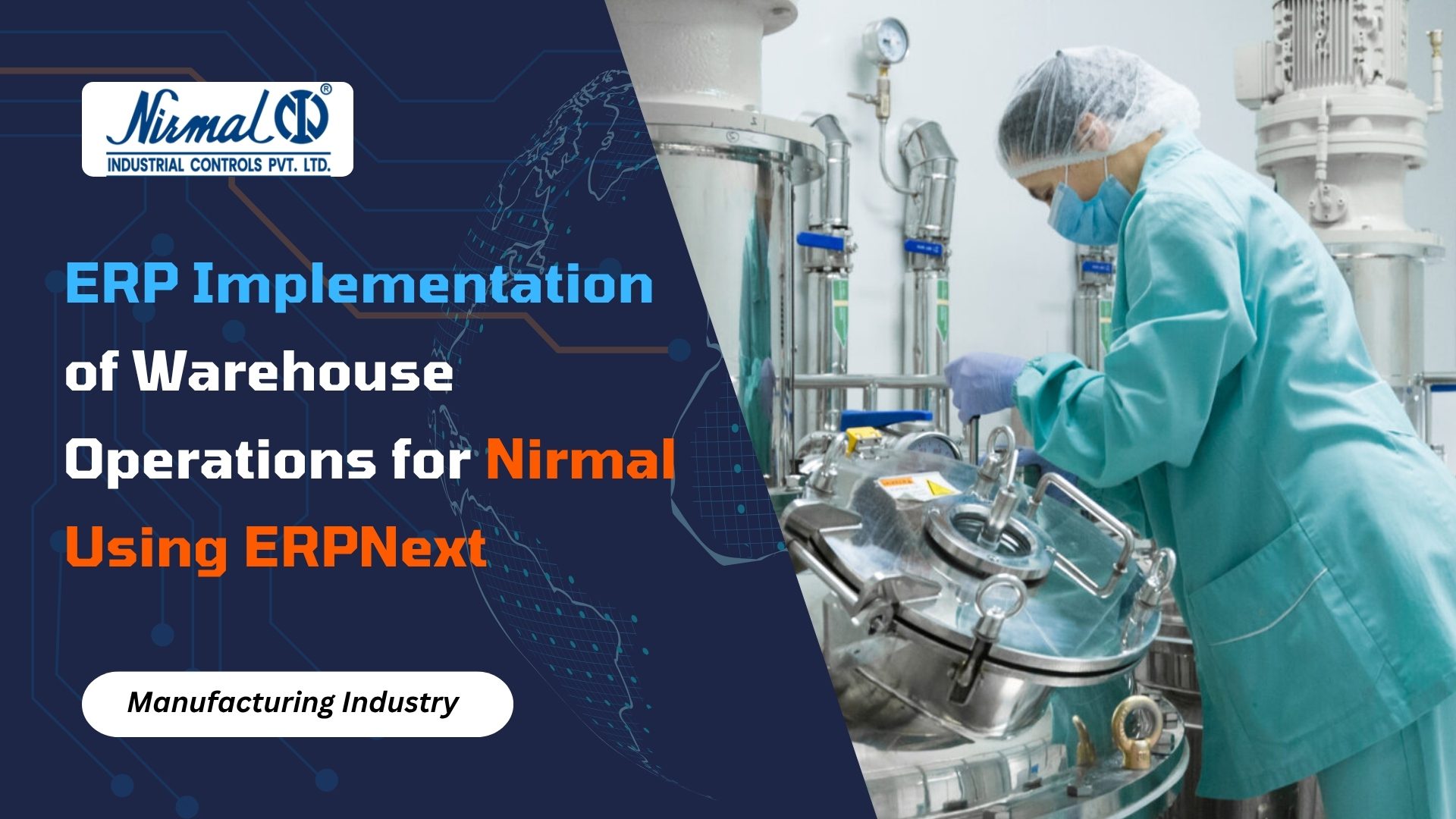
 Nirmal Industrial Controls Pvt. Ltd. is a leading industrial solutions provider known for delivering innovative and reliable control systems across multiple sectors.
With a strong presence through brands such as Nirmal, Securamax, Mesura Nirmal, and REPCO, the company has built a strong reputation for quality engineering, operational reliability, and industrial excellence.
As the organization continued to expand its operations, the company aimed to modernize its internal processes and create a connected digital ecosystem that could efficiently support its growing warehouse, procurement, and subcontracting operations.
Business Challenges
Before implementing ERPNext, Nirmal faced several operational challenges that limited efficiency and operational visibility.
Multiple Disconnected Systems
Different tools were being used to manage warehouse operations, procurement, and production workflows. This resulted in:
- Duplicate data entries across systems
- Lack of centralized data visibility
- Increased dependency on manual coordination
- Higher chances of operational errors
Managing information across separate systems made it difficult to maintain accurate and synchronized operational data.
Manual Vendor Coordination
The procurement team relied heavily on manual communication with vendors and subcontractors through emails and phone calls to track operational updates.
This included:
- Purchase Order status updates
- Subcontracting progress tracking
- Shipment confirmations
This manual process consumed significant time and created delays in operational coordination.
Integration Requirement with SAP Business One
The organization was already using SAP Business One (SAP B1) as its primary ERP system.
However, they required an additional operational platform that could:
- Manage warehouse and subcontracting operations
- Synchronize operational data with SAP B1
- Support two-way API integration between systems
Without proper integration, maintaining consistent data across both systems was a challenge.
Have a look at the previous case study: Manufacturing ERP Transformation: ERPNext Implementation for IMA-PG India.
The Solution
Indictrans implemented a customized ERPNext solution built on the Frappe Framework to streamline warehouse operations and enable seamless integration with SAP Business One.
The implementation focused on:
- Centralizing warehouse and subcontracting operations
- Digitizing operational workflows
- Eliminating manual data duplication
- Enabling two-way API integration with SAP Business One
The project followed an Agile implementation methodology, enabling continuous collaboration, iterative improvements, and flexibility throughout the project lifecycle.
Implementation Approach
1. Requirement Gathering & Process Mapping
The project began with detailed workshops and stakeholder discussions to understand existing workflows and define the future system architecture.
Key activities included:
- Mapping AS-IS operational processes
- Conducting stakeholder consultations
- Documenting workflow requirements
- Obtaining client approval before development
This discovery phase ensured the ERP system aligned closely with Nirmal’s operational processes.
2. Custom Development & Implementation
Based on the documented workflows, Indictrans developed custom ERPNext modules to support the organization’s operational lifecycle.
Key Modules Implemented
- Buying
- Manufacturing
- Subcontracting
- Stock Management
- Quality Management
- Advanced Shipment Note (ASN)
- Custom Print Formats & Reports
- Supplier Portal
- Operational Dashboards
These modules helped the organization digitize and standardize warehouse and subcontracting operations.
3. System Integrations
A two-way API integration was developed between ERPNext and SAP Business One.
This integration enabled seamless synchronization of key operational data, including:
- Buying transactions
- Manufacturing transactions
- Subcontracting Transactions
- Multiple Masters
- Quality Management Transactions
As a result, Nirmal achieved a connected and automated digital ecosystem, ensuring consistent data flow between both platforms.
4. User Acceptance Testing (UAT)
The system rollout was conducted in phases with active participation from multiple departments.
- Key highlights included:
- Multiple feedback cycles with end users
- Continuous improvements during the testing phase
- Close coordination between the Indictrans team and client stakeholders
This iterative approach ensured that the system met operational expectations before final deployment.
5. On-Site Collaboration
To ensure smooth implementation, the Indictrans team worked closely with Nirmal’s internal teams on-site.
- This approach enabled:
- Faster issue identification and resolution
- Immediate support for users
- Improved collaboration and knowledge transfer.
Successful Go-Live
The ERPNext system was successfully deployed across key operational modules and integrated systems.
Although there was some initial resistance to adopting the new system, structured training sessions and ongoing support helped employees transition smoothly.
The system is now actively used to manage warehouse and subcontracting operations.
Outcomes & Business Impact
The ERPNext implementation significantly improved operational efficiency and system integration across the organization.
Centralized Operations
The platform now manages the complete operational lifecycle through integrated modules and two-way SAP synchronization, including
- Buying
- Manufacturing
- Subcontracting
- Advanced Shipment Notes (ASN)
- Supplier Portal
- Quality Management
This centralized approach has improved data accuracy and operational coordination.
Reduced Manual Work
Automation and system integration have significantly reduced manual effort.
Key improvements include:
- Elimination of duplicate data entry
- Automated synchronization with SAP Business One
- Faster transaction processing and operational updates
Improved Vendor Collaboration
The introduction of the Supplier Portal and automated workflows has enhanced communication and coordination with vendors and subcontractors.
This has improved transparency and streamlined procurement processes.
Increasing User Adoption
Through structured training programs and continuous support:
- Employee confidence in the system has increased
- Daily ERPNext usage continues to grow
- Operational transparency across departments has significantly improved
Technology Stack
ERP Platform: ERPNext.
Framework: Frappe Framework.
Integration: SAP Business One (Two-Way API Integration).
Conclusion
The ERPNext implementation enabled Nirmal Industrial Controls Pvt. Ltd. to modernize its warehouse and subcontracting operations by introducing a centralized, scalable, and process-driven digital platform.
By integrating ERPNext with SAP Business One, the organization successfully streamlined operational workflows, eliminated duplicate data entry, and improved system synchronization across departments.
This digital transformation has strengthened operational efficiency, improved transparency, and positioned Nirmal for scalable growth and long-term operational excellence.
 Let’s talk about how the HyperCare Team can support your journey.