About the Client.
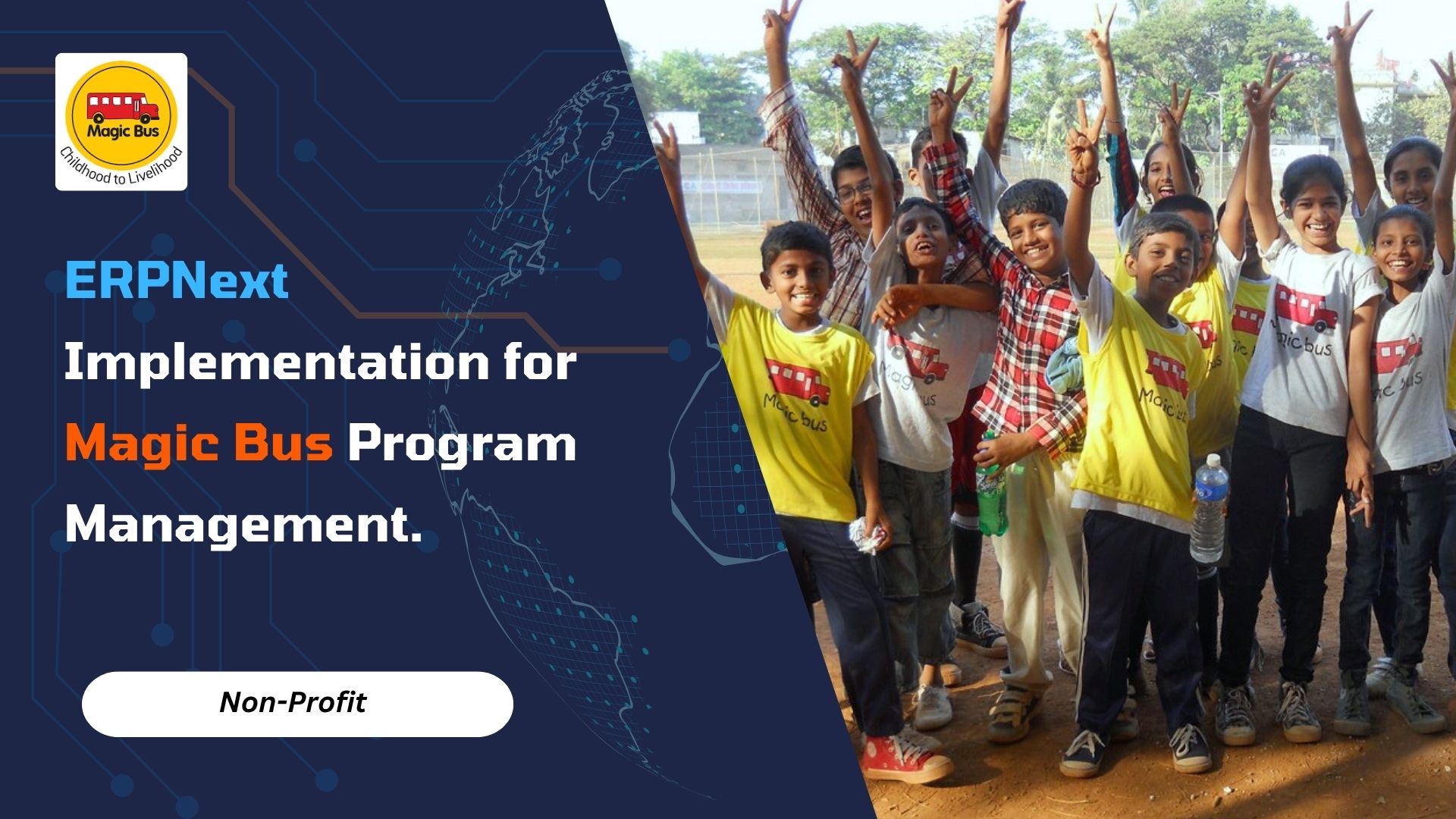
 Magic Bus is one of India’s leading NGOs working in the education and skilling sector. Founded in 1999 in Mumbai, the organization has grown into a nationwide movement supporting young people living in poverty.
Today, Magic Bus helps children and youth transition from a challenging childhood to a future with meaningful livelihoods. Through structured education programs, life-skills development, and employment initiatives, the organization empowers young individuals to build sustainable careers and break the cycle of poverty.
The Challenges.
Before implementing ERPNext, however, Magic Bus faced several operational challenges.
- Firstly, multiple systems were used to manage different processes, which created data silos and fragmented information.
- In addition, there was no centralized platform to manage end-to-end program activities across departments.
- As a result, manual coordination between teams slowed down daily operations and decision-making.
- Moreover, it was difficult to track the complete lifecycle of students, from mobilization and enrollment to placement and alumni engagement.
- At the same time, the organization required a customized system aligned with its internal program workflows and operational structure.
- Furthermore, managing a large number of users across more than 200 centers created additional complexity.
- Therefore, Magic Bus needed a flexible and scalable digital platform to efficiently support program management, training, and placement activities.
Solution Approach.
To address these challenges, Indictrans implemented a customized ERPNext solution built on the Frappe Framework. Importantly, the project followed an Agile implementation methodology to ensure flexibility and continuous collaboration with the client.
The implementation was carried out through a structured, phased approach.
1. Requirement Discovery & Process Blueprinting.
To begin with, the project started with detailed requirement discovery workshops involving key stakeholders from the Magic Bus team.
During this phase, the team:
- Mapped existing AS-IS operational processes.
- Conducted stakeholder discussions across departments.
- Identified operational gaps and improvement opportunities.
- Created a comprehensive business blueprint.
- Obtained client validation and sign-off before development
As a result, the system design closely aligned with the organization’s program workflows and operational requirements.
2. Custom ERPNext Development.
Following the discovery phase, Indictrans developed custom modules within ERPNext based on the defined business blueprint.
Specifically, the solution supported the organization’s full program lifecycle through modules such as:
- Mobilization Management
- Student Enrollment
- Learning Management System (LMS)
- Learning & Assessment Management
- Career Counselling & Interview Preparation
- Placement Management
- Post-Placement Tracking
- Alumni Connect
Consequently, Magic Bus could digitally manage and monitor student progress across all stages of their development journey.
3. System Integrations.
In addition, several external integrations were implemented to strengthen the organization’s digital learning ecosystem.
These included:
- Zoom – for virtual training and learning sessions
- Yellow AI – for automated communication and engagement
- MB Dost – for internal engagement and support
- English Learning Channels- for language learning and training support
Therefore, these integrations created a connected ecosystem for training, communication, and learning delivery.
4. User Acceptance Testing (UAT).
Next, the system was deployed in phases, allowing teams to validate the platform before full rollout.
During the UAT phase:
- Feedback cycles were conducted with multiple departments
- Some delays occurred due to internal decision-making processes
- Continuous follow-ups ensured alignment with timelines
Ultimately, this iterative testing ensured the platform was fully aligned with operational needs before go-live.
5. Onsite Collaboration & Support.
To further support implementation, Indictrans deployed onsite resources to work closely with Magic Bus teams.
This approach helped in:
- Faster issue identification and resolution
- Real-time user support
- Improved collaboration between operational and technical teams
- Faster system adoption
Have a look at the previous case study: Digital Transformation of Warehouse Operations with ERPNext for Nirmal.
Outcomes & Impact.
Implementation Outcome.
As a result of the implementation, the ERPNext solution was successfully deployed across all core program management modules and integrated systems.
Although there were initial operational complexities and some resistance to change, the phased approach, along with continuous support and training, ensured a smooth transition.
Today, the platform is actively used across multiple centers, enabling teams to manage operations more efficiently while improving visibility across departments.
Business Impact.
Overall, the ERPNext implementation significantly improved Magic Bus’s ability to manage large-scale social programs.
By introducing a centralized, structured, and scalable digital platform, the system has:
- Streamlined operations
- Improved team coordination
- Enhanced visibility into program performance and beneficiary progress
Centralized Operations.
Previously, multiple disconnected systems were used across departments.
Now, all program activities are managed within a single integrated platform.
As a result, this centralized approach has improved:
- Data accessibility
- Operational visibility
- Cross-department collaboration
- Reporting accuracy
End-to-End Program Lifecycle Management.
With ERPNext in place, Magic Bus can now track the complete lifecycle of beneficiaries.
This includes:
- Mobilization
- Enrollment
- Training and Learning Programs
- Career Preparation
- Placement Management
- Post-Placement Monitoring
- Alumni Engagement
Consequently, this structured tracking provides better oversight and improves the organization’s ability to monitor student progress.
Strengthened Digital Learning Ecosystem.
Moreover, integrations with platforms like Zoom, Yellow AI, MB Dost, and English Learning Channels have enhanced digital learning capabilities.
As a result, the organization benefits from:
- Virtual learning and training sessions
- Improved communication with beneficiaries
- Technology-enabled program delivery
- Greater accessibility to learning resources
Growing User Adoption.
Initially, there was some resistance to adopting the new system.
However, structured training programs and continuous support helped employees gradually adapt.
Over time:
- Staff confidence has increased
- System usage has grown across teams
- Operational efficiency continues to improve
The platform is now becoming an integral part of the organization’s daily program management activities.
Conclusion.
The ERPNext implementation helped Magic Bus India Foundation successfully transition from fragmented systems to a centralized, scalable, and process-driven digital platform. By digitizing core program workflows and integrating learning and communication tools, the organization can now manage large-scale operations more efficiently across 200+ centers.
The platform enables better visibility across departments, streamlined coordination between teams, and improved tracking of the entire beneficiary lifecycle from mobilization and enrollment to placement and alumni engagement. As user adoption continues to grow, the system is strengthening operational efficiency and supporting Magic Bus in delivering its programs more effectively.
Overall, the implementation demonstrates how a customized ERPNext solution can empower mission-driven organizations to scale their impact while maintaining operational transparency and efficiency.
Indictrans Technologies specializes in implementing and customizing ERPNext solutions to help organizations streamline operations and achieve sustainable growth.
Get in touch with our experts to explore how ERPNext can transform your operations…