
About the Client
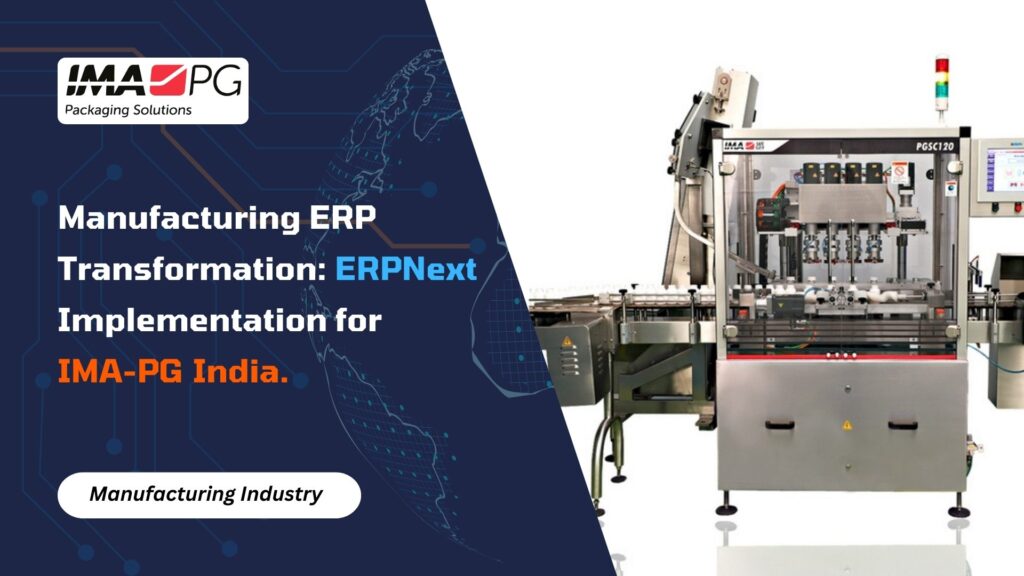
 IMA-PG India Private Limited is a subsidiary of IMA S.p.A., Italy, a global leader in the design and manufacturing of automatic machines used for processing and packaging across industries such as pharmaceuticals, cosmetics, tea, and coffee.
IMA-PG India operates through five branches located in Hyderabad, Bangalore, Indore, Mumbai, and Baddi, with manufacturing plants in Indore and Mumbai.
The company supports a global installation base of more than 2,300 machines across 70+ countries and employs over 400 highly skilled professionals in India. With strong expertise in packaging machinery, the organization plays a significant role in supporting global operations within the IMA Group.
Business Challenges
Before implementing ERPNext, IMA-PG India relied on an internally developed ERP system. However, several operational challenges began to affect process alignment, efficiency, and reporting across the organization.
1. Disconnected Systems Across Locations
Both manufacturing plants operated with different workflows and operational processes, leading to inconsistencies across the organization.
Key challenges included:
- Lack of standardized processes across branches
- Limited visibility of centralized operational data
- Higher dependency on manual coordination and interventions
- Increased risk of operational inefficiencies and errors
These issues made it difficult to maintain consistent operational control across multiple locations.
2. Global Financial Reporting Requirements
IMA-PG India must submit financial reports to its parent organization in Italy. However, the financial reporting structures differed significantly between the two regions.
- In India, financial reporting follows the April–March financial year.
- The parent organization in Italy requires financial reporting based on the calendar year (January–December).
Managing these dual reporting requirements within a single system became a significant operational challenge for the finance team.
Read our previous case study to see ERPNext in action: ERPNext Implementation for India’s Maharatna PSU.
The Solution
Indictrans implemented a customized ERPNext solution built on the Frappe Framework to standardize and streamline operations across the organization.
The implementation focused on:
- Centralizing business operations across locations
- Standardizing workflows across manufacturing plants
- Improving operational visibility and reporting
- Enabling flexible financial reporting aligned with both Indian and global requirements
The project followed an Agile implementation methodology, allowing continuous collaboration, iterative improvements, and flexibility during development.
Implementation Approach
1. Requirement Gathering & Process Mapping
The implementation began with detailed workshops and stakeholder discussions to understand the organization’s existing operational workflows.
Key activities included:
- Mapping AS-IS business processes.
- Conducting stakeholder consultations across departments.
- Documenting workflows and operational requirements.
- Preparing the system blueprint and obtaining client approval before development.
This structured discovery phase ensured the ERP solution aligned closely with the company’s operational structure.
2. Custom Development & Implementation
Based on the documented workflows, Indictrans developed custom ERPNext modules to support the organization’s complete operational lifecycle.
Key Modules Implemented
Buying
- Manufacturing
- Subcontracting
- Selling
- Accounting
- Stock Management
- Quality Management
- Human Resources
- Custom Print Formats & Reports
- Operational Dashboards
These modules enabled the company to digitize and standardize daily operations across departments. The organization also began gradually implementing the HR module as part of its ERP ecosystem.
One of the key customizations implemented was Mirror Accounting, enabling the system to support both:
- Indian financial year reporting (April–March)
- Calendar year reporting (January–December)
This ensured compliance with both local and global reporting requirements.
3. User Acceptance Testing (UAT)
The system was rolled out in phases, allowing different departments to test and validate the system before final deployment.
Key highlights included:
- Multiple feedback cycles with end users
- Continuous improvements based on user input
- Close coordination between the Indictrans implementation team and client stakeholders
This collaborative approach ensured the system met the organization’s operational expectations.
4. On-Site Collaboration
To ensure smoother implementation and faster issue resolution, the implementation team worked closely with internal teams at both Mumbai and Indore locations.
This enabled:
- Faster identification and resolution of issues
- Immediate support for end users
- Better collaboration between operational and technical teams
- Effective knowledge transfer to internal staff
Successful Go-Live
The ERPNext system was successfully deployed across the organization.
Even after go-live, the system continues to evolve through ongoing improvements and enhancements to further optimize operational workflows.
Although there was some initial resistance to the new system, structured training sessions and continuous support helped employees adapt to the platform effectively.
Outcomes & Business Impact
Centralized Operations
IMA-PG India successfully transitioned from fragmented systems to a unified ERP platform, enabling better coordination across departments and locations.
This has significantly improved operational consistency across manufacturing plants.
Improved Operational Visibility
Management now has real-time insights into key business functions, including:
- Procurement
- Production
- Inventory
- Sales operations
This visibility supports better decision-making and operational control.
Increased User Adoption
Through training and ongoing support
- Employee confidence in the system increased
- Daily usage of ERPNext improved
- Operational transparency across departments has significantly improved
Technology Stack
- ERP Platform: ERPNext
- Framework: Frappe Framework
Conclusion
The ERPNext implementation enabled IMA-PG India Private Limited to standardize and streamline operations across its multiple branches and manufacturing plants through a centralized digital platform. By implementing key modules such as Buying, Manufacturing, Subcontracting, Selling, Stock, Assets, and HR, the organization successfully aligned operational processes between its Indore and Mumbai plants. Custom features such as advanced reporting, tailored print formats, and mirror accounting for calendar-based financial reporting ensured that the system met both local compliance requirements and global reporting standards. This digital transformation has strengthened operational control, improved transparency, and positioned IMA-PG India for scalable growth and continued operational excellence.
Looking for a successful ERP transformation in manufacturing? Indictrans helps businesses streamline operations, improve accuracy, and scale confidently with ERPNext.
Speak to our ERPNext experts today…
For more insights, have a look at LInkedIn…