Introduction to Enterprise Automation
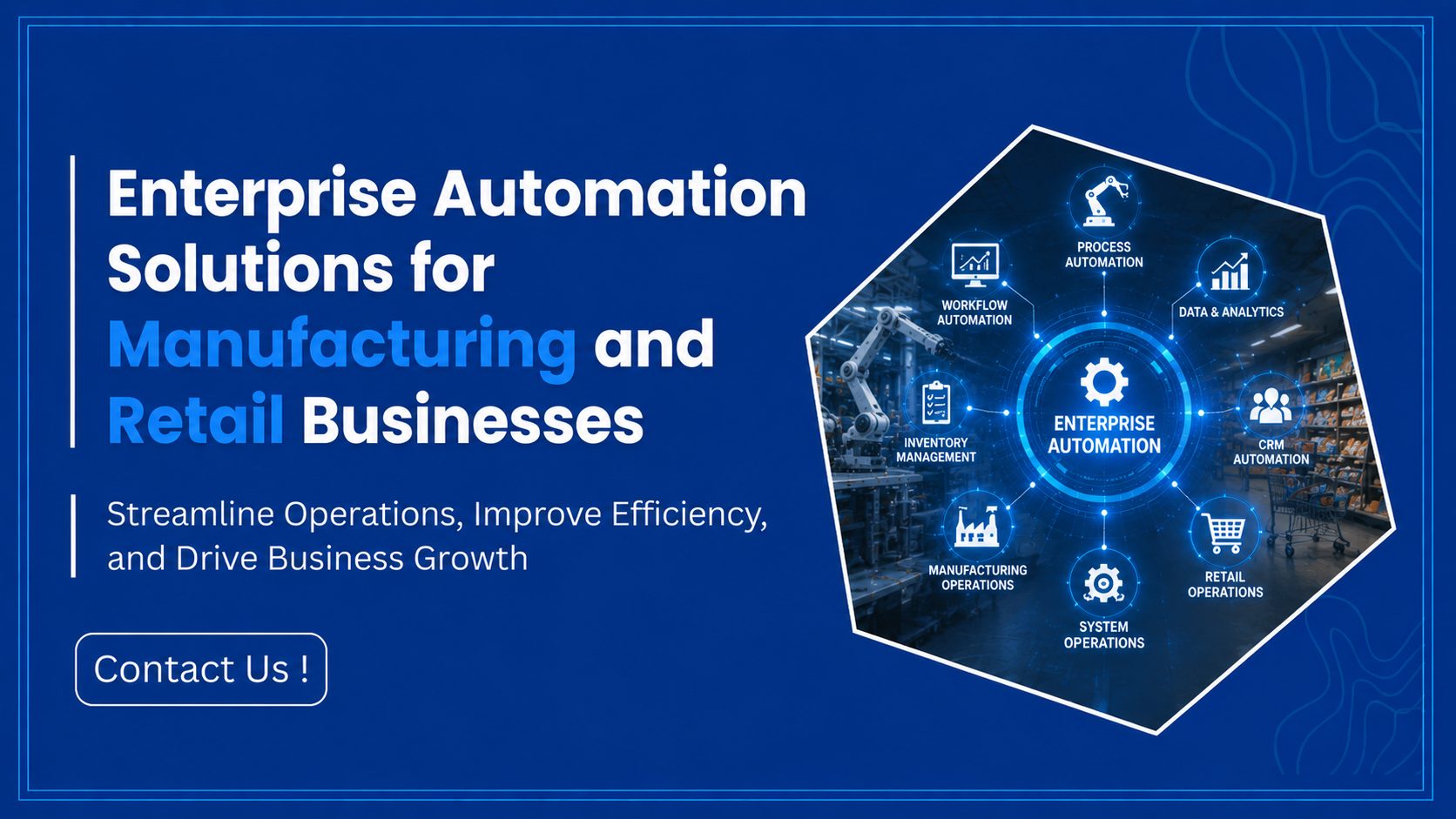
Businesses today are expected to move faster, operate smarter, and deliver better customer experiences while managing increasing operational complexity. Whether it’s a manufacturing company handling production workflows or a retail business managing multiple stores and inventory channels, manual operations are becoming difficult to sustain at scale.
This is where enterprise automation solutions are transforming the way businesses operate.
Enterprise automation refers to the use of digital technologies, ERP systems, and intelligent workflows to automate repetitive business processes, improve operational coordination, and reduce manual dependency across departments.
From inventory updates and procurement approvals to reporting, customer management, and production planning, automation helps businesses streamline day-to-day operations while improving visibility and decision-making.
For manufacturing and retail industries, automation is no longer just about reducing manual effort; it is about building connected, scalable, and future-ready operations.
Modern automation technologies now combine the following:
- ERP automation software
- Cloud-based business systems
- Workflow automation tools
- Analytics platforms
- Smart operational integrations
Together, these technologies help businesses improve efficiency, reduce delays, and create more agile operational environments.
Key Features of Enterprise Automation Solutions
Workflow Automation
One of the biggest operational challenges businesses face is managing repetitive manual tasks across departments.
Tasks such as:
- Purchase approvals
- Inventory updates
- Invoice processing
- Reporting
- Order management
Often consume time, slow down operations, and increase the risk of errors.
Workflow automation helps businesses streamline these repetitive activities through predefined automated processes.
Instead of manually coordinating every step, systems automatically trigger workflows, notifications, approvals, and updates based on business rules.
This improves operational speed, consistency, and efficiency while reducing dependency on manual intervention.
ERP and System Integration
Disconnected systems create operational silos that affect productivity and visibility.
Enterprise automation solutions integrate ERP systems with inventory platforms, finance tools, CRM systems, procurement workflows, and operational applications to create a connected business ecosystem.
With proper integration:
- Departments work with real-time shared data
- Reporting becomes more accurate
- Operational coordination improves
- Decision-making becomes faster
ERP integration ensures businesses operate through a centralised and synchronised environment instead of fragmented systems.
Inventory and Supply Chain Automation
Inventory and supply chain inefficiencies directly impact production, sales, and customer satisfaction.
Automation systems help businesses:
- Track inventory in real time
- Automate stock replenishment
- Improve warehouse coordination
- Monitor procurement cycles
- Streamline logistics operations
For manufacturing businesses, this improves material availability and production continuity. For retail businesses, it ensures better stock accuracy across stores and distribution channels.
Modern industrial workflow automation systems help organisations create more responsive and efficient supply chain operations.
Reporting and Analytics Automation
Businesses generate large amounts of operational data every day, but manual reporting often delays decision-making.
Automation tools simplify reporting by:
- Generating real-time dashboards
- Tracking KPIs automatically
- Monitoring operational performance
- Delivering instant business insights
This helps management teams make faster and more informed decisions based on live operational data rather than delayed manual reports.
Customer Service Automation
Customer expectations continue to grow across both manufacturing and retail sectors.
Businesses need faster responses, better communication, and more consistent support processes.
Automation solutions help improve customer service by:
- Managing customer queries efficiently
- Automating ticket workflows
- Improving communication tracking
- Streamlining support processes
This enhances response times and improves overall customer experience.
Cloud-Based Business Management
Modern businesses require flexibility, scalability, and remote accessibility.
Cloud-based automation platforms provide:
- Centralized access to business systems
- Real-time operational visibility
- Easier scalability
- Improved collaboration across locations
Cloud-based enterprise solutions also reduce infrastructure dependency while supporting business growth and operational flexibility.
Benefits of Enterprise Automation Solutions
Reduced Manual Workload: Automation eliminates repetitive manual tasks, allowing teams to focus on more strategic and operationally valuable activities.
Improved Business Accuracy: Automated workflows reduce human errors and improve data consistency across departments and systems.
Faster Operational Processes: Business operations such as approvals, reporting, procurement, and inventory updates become significantly faster through automation.
Better Productivity and Efficiency: Connected workflows and automated coordination improve overall organizational productivity and operational performance.
Enhanced Business Scalability: Automation systems help businesses scale operations more efficiently without proportionally increasing operational complexity or manual dependency.
How Enterprise Automation Works
Process Mapping and Analysis
Every automation journey begins with understanding existing business processes.
Businesses first evaluate the following:
- Workflow bottlenecks
- Manual dependencies
- Operational delays
- Process inefficiencies
This helps identify areas where automation can create measurable operational improvements.
Automation Tool Configuration
Once workflows are identified, automation tools are configured based on business requirements, operational goals, and departmental processes.
This ensures automation aligns with real business operations instead of forcing businesses to adapt to rigid systems.
System Integration and Testing
Automation solutions work best when integrated with ERP systems, inventory tools, CRM platforms, and operational applications.
Testing ensures workflows, data synchronisation, and operational processes function accurately before deployment.
Monitoring and Optimization
Automation implementation is not a one-time process.
Businesses should continuously monitor workflows, analyse operational performance, and optimise systems based on changing business requirements and operational goals.
Step-by-Step Automation Implementation Guide
Step 1: Assess Existing Processes
Businesses should begin by evaluating operational inefficiencies, workflow gaps, and repetitive manual tasks.
This creates a clear foundation for automation planning.
Step 2: Identify Automation Opportunities
Not every process needs automation.
Businesses should prioritise processes that:
- Consume excessive manual labour
- Cause operational delays
- Affect productivity
- Create reporting or coordination issues
Step 3: Configure Automation Workflows
Automation systems should be configured around business workflows, approval structures, operational requirements, and reporting needs.
Step 4: Employee Training and Adoption
Successful automation depends heavily on user adoption.
Employees should be trained to understand:
- Automated workflows
- System usage
- Reporting tools
- Process changes
This helps businesses maximise automation effectiveness.
Step 5: Continuous Monitoring and Improvement
Businesses should regularly evaluate automation performance, identify opportunities for optimisation, and refine workflows in response to operational growth and evolving requirements.
Best Practices for Enterprise Automation
To maximise automation success, businesses should:
- Standardize operational workflows
- Maintain regular system updates
- Monitor process performance continuously
- Use scalable automation strategies
- Align automation goals with business objectives
Automation works best when technology, people, and processes are aligned effectively.
Common Business Challenges Solved by Automation
Manual Operational Delays: Automation eliminates repetitive manual coordination and speeds up operational workflows.
Data Inconsistencies: Connected systems improve data accuracy and ensure consistency across departments.
Limited Process Visibility: Real-time dashboards and centralised systems improve operational transparency and monitoring.
High Operational Costs: Automation reduces inefficiencies, manual workload, and operational overheads—improving overall cost control.
Why Choose Indictrans for Enterprise Automation?
Enterprise automation requires more than software implementation—it requires a deep understanding of operational workflows and business processes.
At Indictrans, we help businesses build scalable and process-driven automation ecosystems tailored to manufacturing and retail operations.
Our approach focuses on:
- Understanding operational challenges
- Designing customized automation workflows
- Integrating ERP and operational systems
- Improving business visibility and efficiency
- Providing long-term technical support and optimization
We help businesses implement automation solutions that create measurable operational improvements and support long-term scalability.
Conclusion
Enterprise automation is helping manufacturing and retail businesses move toward smarter, faster, and more connected operations.
By automating workflows, integrating systems, and improving operational visibility, businesses can reduce manual dependency, improve productivity, and scale operations more efficiently.
As industries continue to evolve, automation will play an increasingly important role in building agile and future-ready business environments.
Ready to Automate Your Business Operations?
If your business is facing operational delays, disconnected systems, or inefficient manual workflows, it may be time to explore smarter automation strategies.
At Indictrans, we help businesses implement scalable enterprise automation solutions aligned with operational goals and long-term growth plans.
👉 Book a free consultation to evaluate your current operational workflows