
Author – Chirag Modak
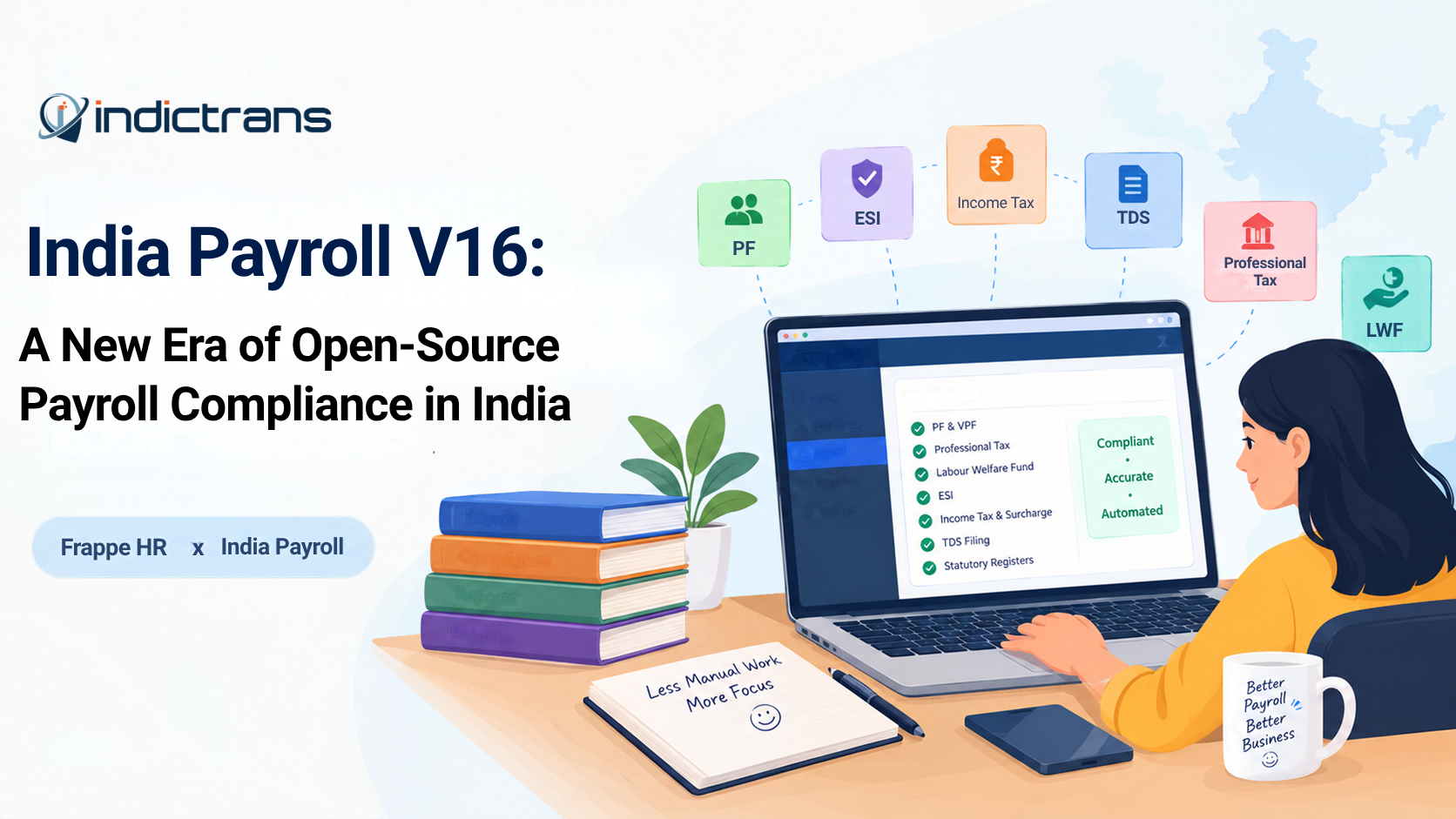
India Payroll V16 brings statutory payroll rules into Frappe HR, helping businesses manage India’s complex payroll requirements.
The Provident Fund has wage ceilings, Professional Tax varies by state, the Labour Welfare Fund follows different schedules, ESI has coverage thresholds, income tax has multiple regimes, and payroll teams also have to manage quarterly TDS returns.
Moving From Manual Configuration to Built-In Compliance
One of the biggest changes with India Payroll is the reduction in manual payroll configuration.
Instead of creating and maintaining separate formulas and configurations for different statutory requirements, the India Payroll extension provides the relevant statutory schemes as part of the payroll system.
This covers areas such as Provident Fund, Employee State Insurance, Professional Tax, Labour Welfare Fund, income tax, and TDS.
Provident Fund: More Flexibility Without Custom Formulas
The provident fund is often treated as a straightforward percentage deduction, but payroll calculations can become more complex when employees opt for voluntary contributions or when contributions need to be calculated on actual wages.
India Payroll V16 brings these scenarios directly into Frappe HR.
The statutory Employee Provident Fund contribution is calculated at 12%, while employees can also make Voluntary Provident Fund contributions. VPF can be configured either as a fixed amount or as a percentage, giving employees flexibility without requiring separate salary formulas.
The system also supports contribution on actual wages for higher earners, rather than limiting the calculation to the standard wage ceiling. This makes the PF calculation flexible enough to handle both the statutory contribution and voluntary or higher-wage contribution scenarios within the payroll process.
The employer-side calculation is also handled within the India Payroll layer. The employer contribution is reconstructed across EPF, EPS, EDLI, and administrative charges, so the different components of the employer contribution are represented within payroll rather than requiring separate manual calculations.
Once the payroll is processed, the resulting PF data can also be taken into the Provident Fund Register, with an ECR export that is ready for upload to the EPFO portal. This connects the calculation on the salary slip with the subsequent statutory reporting requirement.
PF is no longer just a salary component that payroll teams have to configure manually. India Payroll covers the statutory contribution, voluntary contribution, wage ceiling handling, employer contribution split, and ECR output as part of its functionality.
Professional Tax: State-Wise Compliance Without Manual Slab Configuration
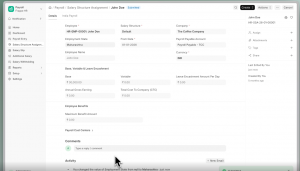
Professional Tax is one of the clearest examples of why Indian payroll needs regional compliance logic.
The calculation is not identical across India. Different states have different slabs and rules, while some states follow monthly calculations and others follow a half-yearly calculation.
India Payroll V16 introduces a state-wise Professional Tax slab engine covering 15+ states. Instead of manually encoding each state’s slabs, the system uses the employee’s Employment State to determine the applicable Professional Tax calculation and deducts the appropriate amount on the salary slip.
The Employment State is maintained on the Salary Structure Assignment, rather than relying on the state field in the Employee master.The system also associates the applicable Professional Tax rule with the employee’s salary structure assignment.
The system supports both monthly and half-yearly Professional Tax states.
For monthly states, the system calculates the applicable PT amount using the state’s gross-pay slabs for that month.
For half-yearly states such as Kerala and Tamil Nadu, the calculation works on cumulative gross pay for the applicable half-year period. The system considers the PT already deducted during that period and calculates the remaining amount accordingly.
India Payroll also handles state-specific rules rather than treating every state as a generic slab calculation.
India Payroll automatically applies these rules to the salary slip and generates the appropriate Professional Tax deduction.
The resulting data is also available through the Professional Tax Register, providing a statutory report alongside the payroll calculation.
Labour Welfare Fund: Following Each State’s Schedule
Labour Welfare Fund has another layer of complexity because states can follow different contribution frequencies and contribution splits.
India Payroll supports LWF across 14 states, applying the applicable employee and employer contributions according to the relevant monthly, half-yearly, or annual schedule.
This means payroll does not have to treat LWF as a single generic calculation across all states.
Employee State Insurance: Built-In Wage Ceilings
Employee State Insurance (ESI) eligibility depends on the applicable wage ceiling, making accurate wage evaluation an important part of payroll processing.
India Payroll brings this eligibility logic directly into Frappe HR. The system automatically applies the applicable ESI wage ceiling when determining whether an employee falls under ESI coverage. It also supports the raised wage ceiling applicable to employees with disabilities.
A particularly important part of the calculation is how the system evaluates an employee’s wages. India Payroll considers the employee’s full monthly gross when determining ESI eligibility rather than simply using the reduced payable amount after Loss of Pay.
This matters in situations where an employee’s payable salary decreases because of Loss of Pay. A high-earning employee should not become eligible for ESI just because Loss of Pay reduces their salary for a particular month.
By evaluating the full monthly gross, India Payroll keeps the ESI eligibility calculation aligned with the applicable wage-ceiling logic while handling Loss of Pay correctly.
This is another example of the difference between simply adding an ESI salary component and building the statutory calculation logic into payroll itself.
Surcharge and Marginal Relief
Income tax calculations can become more complex when an employee’s income crosses a surcharge threshold. A relatively small increase in income can otherwise lead to a noticeable increase in the overall tax liability.
India Payroll handles surcharge and marginal relief calculations directly within the payroll process, applying the applicable rules when determining the employee’s tax liability.
The marginal relief calculation handles the additional tax arising around the surcharge threshold according to the applicable tax rules, rather than treating the surcharge as a simple additional percentage.
By bringing both surcharge and marginal relief into the payroll calculation, India Payroll reduces the need for separate manual tax calculations for employees falling around these income thresholds.
A Guided Tax Regime Comparator
Employees have to choose between the Old and New Tax Regimes, and determining which regime is more beneficial can involve several calculations.
India Payroll provides a guided tax regime comparator where employees can declare relevant exemptions and investments and compare their tax liability under both regimes.
The system recommends the regime with the lower tax liability and writes the selected regime back to the employee’s Salary Structure Assignment.
This shifts the process from a payroll manager manually determining and recording the employee’s choice to a guided process where employees can make the comparison themselves.
TDS Filing From the Payroll System
India Payroll covers new and old tax regime slabs, surcharge with marginal relief, quarterly TDS return (Form 24Q) e-filing through the Sandbox API, and Form 16 generation.
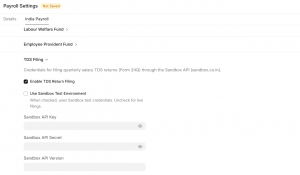
For TDS return filing, the required settings can be configured directly from Payroll Settings. Users can enable TDS Return Filing and configure the required API details for the filing process.
The TDS Filing settings include:
- Enable TDS Return Filing – Enables the TDS return filing functionality.
- Use Sandbox Test Environment – Allows users to perform TDS filings using Sandbox test credentials. This can be disabled when performing live filings.
- Sandbox API Key – API key required for Sandbox integration.
- Sandbox API Secret – API secret required for Sandbox integration.
- Sandbox API Version – Specifies the API version used for the Sandbox integration.
Once the TDS filing functionality is enabled and the required Sandbox API details are configured, the quarterly TDS filing process follows four steps:
- Validate the Return
- Generate TXT
- Generate FVU
- E-File
This allows the TDS return filing workflow to be managed from within the payroll system, with the Sandbox API providing the integration for e-filing.
Statutory Registers Ready for Filing
Payroll compliance does not stop after calculating deductions. The payroll team also needs to report this data in the formats required by the relevant authorities.
India Payroll provides statutory registers and filing exports for:
- EPF, including ECR export for the EPFO portal.
- ESIC, including the relevant return format.
- Professional Tax, through the Professional Tax Register.
- Labour Welfare Fund, through the LWF Register.
- Bank Mandate, through the Bank Mandate Report.
The official India Payroll feature page also highlights EPF, ESIC, and LWF registers as ready-to-file reports.
What Also Comes With Frappe HR V16?
Alongside India Payroll, Frappe HR V16 includes features that complement payroll processing.
These include the Employee CTC Break Up Report and Employer Contribution Salary Components.
These additions help provide a clearer view of employee compensation and employer-side payroll contributions within Frappe HR.
The Bigger Picture
The interesting part of India Payroll is not simply the number of statutory components it supports.
The bigger change is where the compliance logic lives.
Indian payroll rules can involve state-specific slabs, contribution frequencies, wage ceilings, tax regimes, surcharge calculations, and statutory returns. India Payroll brings these requirements into the Frappe HR payroll environment rather than leaving businesses to build each calculation manually.
It also follows the open-source approach of Frappe HR. The India Payroll repository describes the app as a free and open-source layer for Indian statutory payroll and taxation.
Conclusion
India Payroll V16 takes a large part of the complexity out of Indian payroll compliance by bringing statutory calculations and reporting into Frappe HR.
From EPF, VPF, ESI, Professional Tax, and Labour Welfare Fund to income tax, surcharge and marginal relief, tax regime selection, statutory registers, and Form 24Q TDS filing, the objective is the same: reduce the amount of manual configuration required to run Indian payroll.
For businesses using Frappe HR, this means Indian statutory payroll is no longer something that has to sit separately from the payroll system.
It becomes part of the payroll workflow itself.
India Payroll is a practical example of what open-source compliance can look like: the rules are brought into the platform, the calculations happen within payroll, and the resulting data can move directly into compliance reports and returns.
Ready to simplify payroll compliance with Frappe HR?
Talk to our ERP experts to see how India Payroll can help bring statutory payroll calculations, reporting, and compliance into one system.
Do Follow Us on LinkedIn!