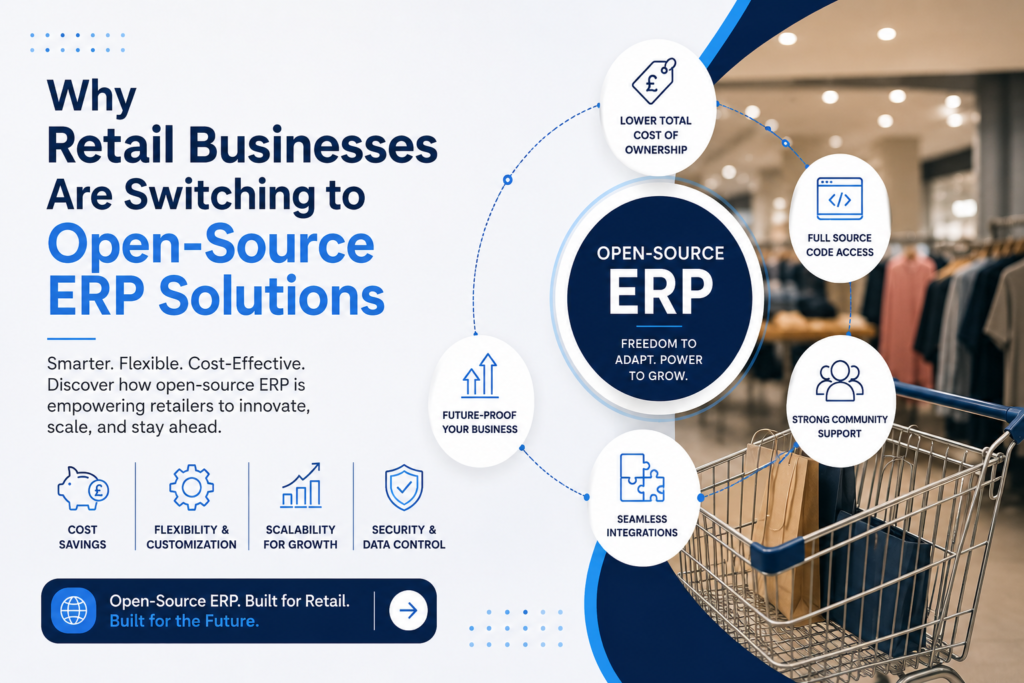

The retail industry has changed dramatically over the last few years.
Customers now expect a seamless shopping experience whether they buy online, visit a store, place an order through social media, or use a mobile app. At the same time, retailers are dealing with rising operational costs, inventory challenges, supply chain disruptions, and increasing competition.
Many businesses are discovering that traditional retail software systems are no longer enough to support modern retail operations.
When inventory is managed in one system, billing in another, and accounting in a third, and customer information is spread across multiple platforms, businesses lose visibility and efficiency. Teams spend more time managing systems than serving customers and growing the business.
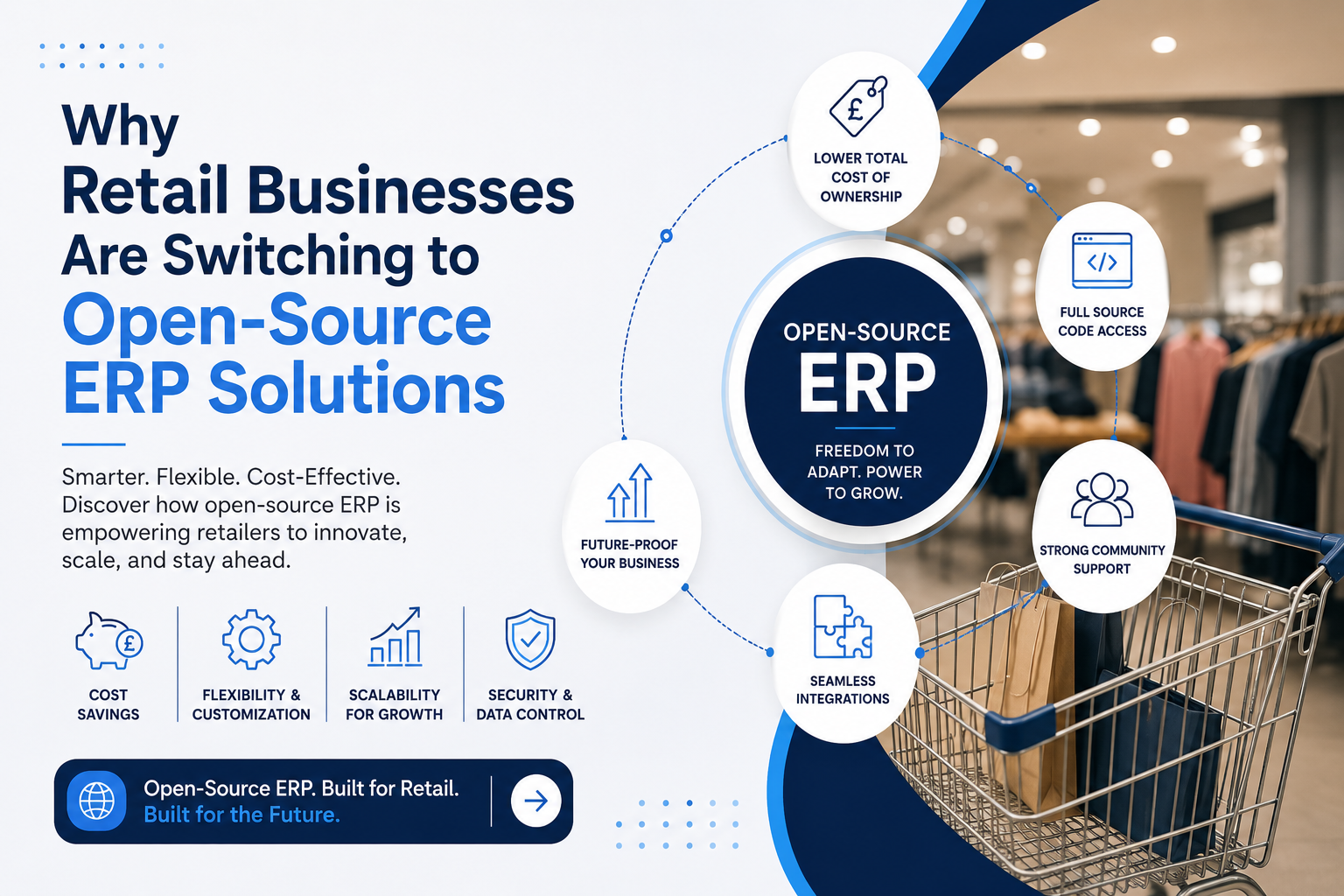
This is one of the key reasons why retailers are increasingly adopting open-source ERP solutions.
An open-source ERP platform brings inventory, point-of-sale (POS), accounting, customer management, purchasing, warehouse operations, and reporting into a single system. It gives retailers greater control over their operations while reducing software costs and improving scalability.
In this article, we explore why retail businesses are moving towards open-source ERP solutions, the benefits they offer, and how platforms like ERPNext are helping retailers modernise their operations.
The Growing Need for Digital Transformation in Retail
Retail has become more data-driven than ever before.
Whether it’s managing inventory across multiple stores, tracking customer buying patterns, forecasting demand, or ensuring product availability, retailers need accurate, real-time information.
Businesses that continue relying on spreadsheets or disconnected systems often struggle to keep up with changing customer expectations.
Challenges Faced by Modern Retail Businesses
Retailers face several operational challenges:
- Inventory inaccuracies
- Overstocking and stock shortages
- Multiple software systems that don’t communicate
- Slow reporting processes
- Difficulty managing online and offline sales
- Rising operational costs
- Inconsistent customer experiences
As businesses expand, these challenges become increasingly difficult to manage manually.
Rising Demand for Scalable Retail Management Systems
Growth should not create operational chaos.
Whether a retailer operates one store or fifty locations, the need for centralised visibility remains the same.
Modern ERP systems help retailers standardise processes, automate workflows, and gain complete visibility across their business operations.
Why Traditional Retail Software Is No Longer Enough
Many traditional retail systems were designed for a single function such as billing, inventory management, or accounting.
Today’s retail environment requires these functions to work together.
Without integration, businesses often face:
- Duplicate data entry
- Reporting inaccuracies
- Delayed decision-making
- Higher administrative costs
This is where open source ERP solutions provide a significant advantage.
What Is an Open-Source ERP Solution?
An open-source ERP solution is a business management platform whose source code is publicly available and can be customised to meet specific business requirements.
Unlike proprietary software, open-source ERP platforms offer greater flexibility and freedom.
Retailers are not locked into rigid workflows or expensive licensing structures.
How Open-Source ERP Works for Retail Businesses
Open-source ERP software integrates multiple retail functions into one system, including:
- Inventory Management
- Point of Sale (POS)
- Procurement
- Warehouse Management
- Customer Relationship Management (CRM)
- Accounting
- Reporting and Analytics
This creates a single source of truth across the organisation.
Difference Between Traditional ERP and Open-Source ERP
| Feature | Traditional ERP | Open-Source ERP |
| Licensing Cost | High | Lower |
| Customization | Limited | Extensive |
| Vendor Lock-In | High | Low |
| Flexibility | Moderate | High |
| Scalability | Depends on Vendor | Highly Scalable |
| Community Support | Limited | Strong |
Key Reasons Retail Businesses Are Choosing Open-Source ERP
Lower Software and Operational Costs
One of the biggest advantages of open-source ERP is cost efficiency.
Retailers can reduce licensing expenses while investing more in process improvements and business growth.
Flexibility and Customization for Retail Operations
Every retail business operates differently.
Open-source ERP allows businesses to customise workflows, reports, approval processes, and integrations according to their specific requirements.
Better Inventory and Supply Chain Management
Inventory accuracy directly impacts profitability.
Open source ERP systems help retailers:
- Track inventory in real time
- Automate stock replenishment
- Manage multiple warehouses
- Improve supplier collaboration
- Reduce stock-outs
Real-Time Reporting and Retail Analytics
Retail decisions should be based on data, not assumptions.
ERP systems provide visibility into:
- Best-selling products
- Slow-moving inventory
- Sales performance
- Profitability
- Customer behavior
Seamless Multi-Store and Omnichannel Retail Management
Retailers operating multiple stores require centralised visibility.
An ERP system enables businesses to manage inventory, sales, and operations across locations from a single platform.
Why ERPNext Is a Preferred Open-Source ERP for Retail
Unlike many retail management systems that focus on one aspect of the business, ERPNext provides a fully integrated platform.
Comprehensive Retail Management Features
ERPNext includes:
- Point of Sale (POS)
- Inventory Management
- Procurement
- CRM
- Accounting
- Warehouse Management
- Reporting & Dashboards
Integrated POS, Inventory, CRM, and Accounting
Every transaction automatically updates inventory and financial records, reducing manual effort and improving accuracy.
Cloud-Based and Easy-to-Use ERP Platform
ERPNext can be deployed on the cloud, making it accessible from anywhere while reducing infrastructure costs.
Customizable ERPNext Modules for Retail Businesses
Retailers can tailor workflows, forms, reports, and dashboards to match their operational requirements.
Why Choose Indictrans for Open-Source ERP Implementation?
Implementing ERP software requires more than technology. It requires industry expertise, process understanding, and long-term support.
Expertise in ERPNext Retail Solutions
Indictrans has extensive experience implementing ERPNext for businesses across industries, helping organisations streamline operations and improve visibility.
Tailored ERP Implementation for Retail Businesses
Every retail business has unique requirements. Indictrans works closely with clients to configure ERPNext based on their processes, operational structure, and growth plans.
Ongoing Support, Customization, and Training
Successful ERP adoption requires continuous support. From implementation to optimisation, Indictrans helps businesses maximise the value of their ERP investment.
Conclusion
Retail businesses can no longer rely on disconnected systems to manage modern operations.
As customer expectations rise and competition increases, retailers need better visibility, stronger inventory control, faster decision-making, and seamless omnichannel management.
Open source ERP solutions provide the flexibility, scalability, and affordability required to support these goals.
For retailers looking to modernise operations, improve inventory management, and create a connected business environment, ERPNext offers a powerful and future-ready solution.
With the right implementation partner, businesses can move beyond operational challenges and build a strong foundation for sustainable growth.
Frequently Asked Questions
What is the best open-source ERP for retail businesses?
ERPNext is one of the most widely adopted open-source ERP platforms for retail businesses due to its integrated POS, inventory, CRM, accounting, and reporting capabilities.
How does ERP software help retail businesses?
ERP software helps retailers manage inventory, sales, procurement, accounting, customer data, and reporting from a single platform.
Is open-source ERP secure?
Yes. Modern open-source ERP platforms follow strong security practices and can be configured to meet business-specific security requirements.
Can ERPNext manage multiple retail stores?
Yes. ERPNext supports multi-store inventory management, centralised reporting, and omnichannel retail operations.
Why should retailers choose cloud ERP?
Cloud ERP offers remote access, greater scalability, automatic updates, and lower infrastructure costs than traditional systems.
This style has a much higher chance of ranking because it focuses on retail business problems first, ERP solutions second, and ERPNext third, which aligns with how both Google and AI search engines evaluate content quality.