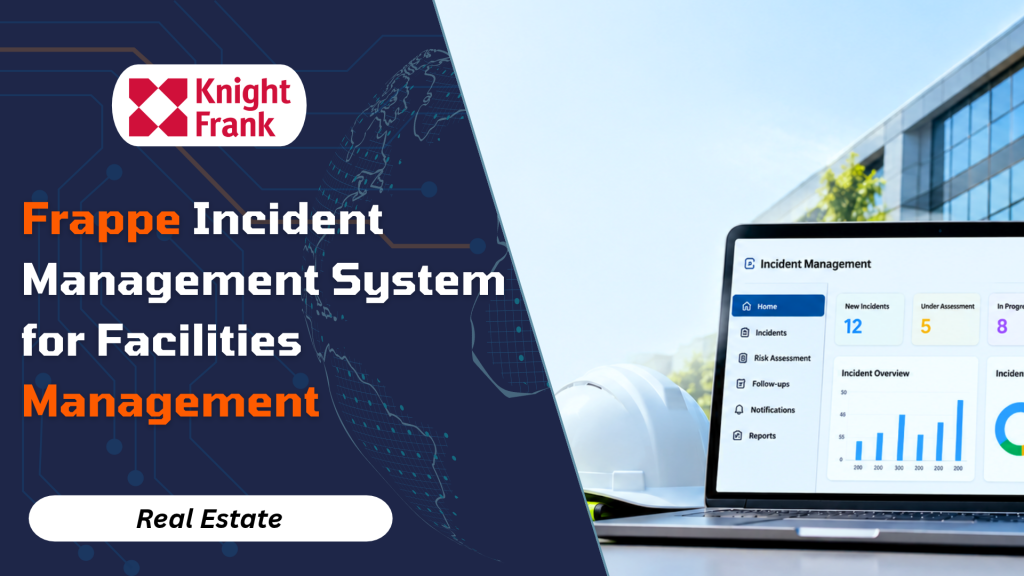
Managing incidents across multiple operational sites requires more than just recording what happened. Teams need a structured process to report incidents, assess risks, share updates with the right stakeholders, and track follow-up actions at every stage.
To address these requirements, Knight Frank India worked with Indictrans to develop a customized Incident Management System using the Frappe platform. The application brings the entire reporting process together through a central First Information Report (FIR), connecting 24-hour, 48-hour, and 30-day reports with risk assessments, email notifications, workflows, and management dashboards.
This gives Knight Frank a structured way to manage incident information from the initial report through investigation and subsequent follow-ups.
About the Company
Knight Frank India is a leading real estate consultancy firm providing services across Facilities Management, Project Management, Valuation, Advisory and other real estate sectors. Its operations involve coordination between on-site teams, management stakeholders and clients, making reliable operational information an important part of service delivery.
Industry & Domain
This project sits within the Facilities Management domain, where incidents at operational sites need to be recorded, assessed and communicated to the appropriate stakeholders. Depending on the nature of an incident, teams may need to provide an initial report, a more detailed follow-up and later updates as the investigation progresses.
ERPNext Implementation
Knight Frank required an incident management application that reflected its own reporting stages and operational rules. The project therefore focused on adapting the Frappe platform to the incident reporting process rather than forcing the process into a generic, one-size-fits-all transaction.
A customized Frappe application was developed around a central First Information Report (FIR), with connected reporting stages, risk assessment, stakeholder communication and management views. Custom DocTypes and selected standard ERPNext functionality were used where appropriate.
The Challenges
The central challenge was not simply to create a form for recording an incident. Knight Frank needed a consistent way to carry an incident through its reporting lifecycle from the first notification at a site to subsequent assessment and follow-up while keeping the relevant people informed.
Each incident could involve different site and client details, different levels of impact, and different stakeholders. The reporting process also required information at specific intervals. The application therefore had to bring together several connected needs:
- Capture essential site, client, incident date, time, location, and classification details in a consistent record.
- Record evidence, injury information, immediate actions, and investigation observations without separating them from the incident.
- Support the 24-hour, 48-hour and 30-day reporting requirements as the incident develops.
- Assess potential and actual impact across people, assets, community, and environment.
- Direct communications to the relevant Knight Frank and client contacts, taking configured business conditions such as FAMS control into account.
- Give teams a clear view of reporting progress, review stages, and outstanding follow-up.
The Solution
The solution was designed around the way an incident moves through the Facilities Management reporting process. Instead of treating each report as a separate activity, the team established the FIR as the central record and organised the required information around it. This gives users a common starting point and a connected place to maintain incident updates.
- A single record from the first report
When an incident is reported, the FIR captures the site code and name, site manager, city, region, client information, key account manager and FAMS control status, along with the incident reference. The incident section records the date, time, location, type and NERA rating. Injury details, incident documents and picture evidence can be attached to the same record, while narrative fields capture what happened and the additional context.
- Reporting that follows the incident lifecycle
The reporting process is organized into three milestones so that information can be added as it becomes available:
- 24-hour report – documents the initial incident account, supporting evidence, injury details, immediate actions, and early observations.
- 48-hour report – adds follow-up information and a structured assessment of potential and actual risk across people, assets, community, and environment.
- 30-day report – provides a stage for subsequent investigation updates, corrective or preventive action progress, and closure-related follow-up, in line with the business reporting requirements.
- Risk assessment as part of the report
The 48-hour section incorporates a severity and likelihood matrix and captures potential and actual risk for the key impact categories. This makes risk information part of the incident record itself, rather than leaving it disconnected from the reporting history.
- Communication and process control
The FIR maintains email recipient details for the Knight Frank team and client-side contacts. Configured notification rules support incident-related communication, including business-specific conditions such as FAMS control status. Workflows support the required reporting, review and submission stages so that the process can be followed consistently.
- Management visibility
Reports and dashboards provide access to incident information and reporting status. Role-based access can be applied to relevant application functions where configured, helping align access with user responsibilities.
Results & Business Impact
The customized system provides Knight Frank with a structured application process for managing incident information from initial reporting through follow-up. By bringing the incident record, supporting evidence, risk assessment and reporting milestones together, the solution supports a more connected view of each incident.
- More structured records: site, client, incident and evidence information can be maintained together in the FIR.
- Consistent milestone reporting: the 24-hour, 48-hour and 30-day stages provide a defined structure for reporting updates.
- Clearer risk information: severity, likelihood and impact categories are captured as part of the incident reporting process.
- Coordinated communication: configured recipients and notification rules support communication with relevant internal and client stakeholders.
- Improved process visibility: workflows, reports and dashboards help users view reporting progress and incident information.
- A foundation for ongoing improvement: the configurable Frappe application can be enhanced as operational reporting requirements evolve.
These are process and capability outcomes based on the implemented scope; no quantified improvement figures or performance claims are asserted.
Key Learnings
The project reinforced that effective incident management depends on more than capturing information. The reporting stages, risk assessment, communication rules and follow-up responsibilities need to work as one process.
- Understanding what users need to report at each stage helps shape the application around real work.
- A central record makes it easier to relate the initial report to evidence, risk assessment, and later updates.
- The system applies FAMS control conditions and recipient selection rules when sending notifications.
- Initial reports and later follow-ups need different levels of detail as facts become available.
Closing Takeaway
With Frappe, we developed a connected digital workflow that reflects Knight Frank’s specific business processes. By organizing incident registration, multi-stage reporting, risk assessment, and stakeholder communication around a central FIR, the solution supports a more consistent approach to incident management across operational sites.
The value of the implementation lies not only in digitizing forms but also in connecting the steps that teams follow after an incident occurs, capturing what happened, assessing its impact, sharing the right information, and maintaining visibility as the incident progresses.
Looking to Improve Incident Management Across Your Facilities?
Manage incident reporting, risk assessments, stakeholder communication, and follow-ups through a structured Frappe-based application.
Talk to our team to explore a solution that fits your operational requirements.