When a customer places an order, a lot has already happened before that product reaches their hands.
A supplier may have delivered the raw material. The procurement team may have raised a purchase order. The warehouse may have received and stored the stock. The production team may have planned the manufacturing schedule. And finally, the finished product needs to reach the customer on time.
All of these activities are connected.
That is where Supply Chain Management (SCM) comes in.
Supply chain management is the process of planning and managing the movement of materials, products, information, and resources from suppliers to customers.
For a growing business, this becomes increasingly important. More suppliers, products, warehouses, customers, and locations also mean more things that need to work together.
In this guide, we’ll look at what supply chain management is, how it works, its key activities, common challenges, and how businesses can improve their supply chain operations.
What Is Supply Chain Management?
In simple terms, supply chain management is about making sure the right things reach the right place at the right time.
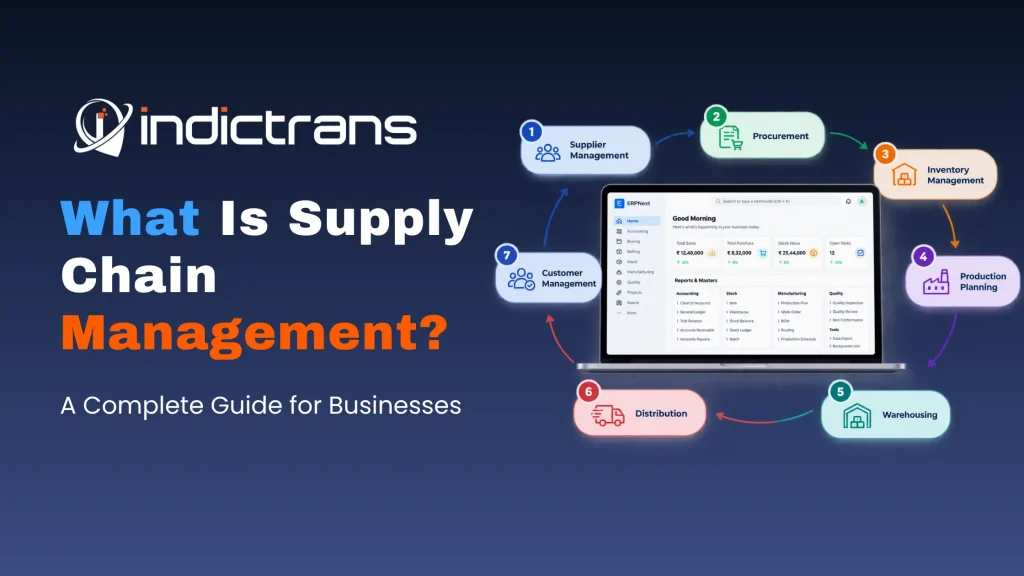
It starts with understanding what the business needs and continues through procurement, inventory, production, warehousing, distribution, and customer delivery.
A typical supply chain may look something like this:
Supplier → Procurement → Inventory → Production → Warehouse → Distribution → Customer
Of course, the actual flow depends on the business.
A manufacturing company may need to manage raw materials, production schedules, quality checks, finished goods, and multiple warehouses.
A distributor may focus more on purchasing, inventory availability, warehouse operations, and order fulfillment.
A retailer may need to keep products available across stores, warehouses, and online channels.
The processes are different, but the basic challenge is the same: keeping everything connected.
What Does SCM Mean in Business?
SCM stands for Supply Chain Management.
In business, SCM means managing the activities that help move materials, products, information, and resources from suppliers to customers.
It connects areas such as procurement, inventory, production, warehousing, logistics, and order fulfillment.
The idea is simple: instead of each department working separately, the business looks at the supply chain as one connected process.
For example, a manufacturing company needs raw materials before production can start. Production needs to be aligned with demand, finished goods need to reach the warehouse, and customer orders need to be fulfilled on time.
When these activities are connected, teams have better visibility and can make decisions based on what’s actually happening across the business.
How Does Supply Chain Management Work?
There isn’t one single activity called supply chain management.
It is a combination of processes that work together.
It starts with planning
Before buying anything or starting production, businesses need to understand what customers are likely to need.
Demand forecasts, previous sales, seasonality, current inventory, and upcoming orders can all help with this planning.
The better the planning, the easier it becomes to decide what needs to be purchased or produced.
Then comes sourcing and procurement
Once requirements are clear, the business needs to source the required materials or products.
This can involve comparing suppliers, requesting quotations, negotiating terms, placing purchase orders, and tracking deliveries.
A supplier delay at this stage can easily create problems further down the chain.
Inventory needs to stay under control
Once materials or products arrive, the business needs to know:
What came in? Where is it stored? How much is available? What has already been allocated?
This sounds simple, but it becomes difficult when a business has thousands of products or operates across multiple locations.
Too little inventory can result in stockouts.
Too much inventory can tie up money and increase storage costs.
SCM helps businesses find a practical balance.
Production or order preparation follows
For manufacturers, available materials need to match production plans.
For distributors and retailers, the focus may be on allocating stock and preparing customer orders.
Either way, teams need accurate information to know what can actually be fulfilled.
Finally, products need to reach the customer
Once an order is ready, it needs to be picked, packed, shipped, and delivered.
And the process doesn’t necessarily end there.
Returns, replacements, repairs, and other reverse logistics activities can also become part of the supply chain.
What Are the Main Supply Chain Activities?
Supply chain management covers several activities, but they aren’t separate islands.
Each one affects the next.
Demand Planning
Demand planning helps businesses estimate what customers are likely to need.
It influences purchasing, inventory levels, production, and capacity planning.
Procurement
Procurement is about getting the required materials or products from suppliers.
But good procurement isn’t simply about finding the cheapest supplier. Lead time, quality, reliability, payment terms, and supplier performance also matter.
Inventory Management
Inventory management is about knowing what stock you have, where it is, and when you need more.
The challenge is avoiding both extremes: too much stock and not enough stock.
Production Planning
For manufacturers, production needs to match demand while considering materials, machines, people, capacity, and schedules.
A problem with any one of these can affect the production plan.
Warehouse Management
Once inventory reaches a warehouse, it needs to be received, stored, moved, picked, packed, and dispatched properly.
As businesses add more warehouses and locations, this becomes harder to manage manually.
Order Management
Order management connects customer demand with inventory and fulfillment.
A customer may place an order, but fulfilling it requires the business to know whether the product is available, where it is located, and how quickly it can be delivered.
Logistics and Distribution
The final movement of goods involves transportation, shipment planning, delivery tracking, and sometimes returns.
For businesses operating across regions or countries, logistics can become one of the more complex parts of the supply chain.
Supply Chain Performance Management
Managing a supply chain isn’t only about keeping products moving. Businesses also need to know whether the supply chain is performing well.
Supply chain performance management involves tracking the areas that have the biggest impact on operations, such as:
- Inventory levels and turnover
- Supplier lead times
- Purchase costs
- Order fulfillment
- On-time delivery
- Warehouse performance
- Stockouts
- Overall supply chain costs
The right KPIs will depend on the business.
A manufacturer may pay more attention to production and material availability, while a distributor may focus more on inventory movement, warehouse performance, and order fulfillment.
The important part is to measure what matters and use that information to identify where the supply chain needs improvement.
What Are Supply Chain Operations?
Supply chain operations are the day-to-day activities that keep the supply chain running.
This includes purchasing materials, receiving inventory, storing and moving stock, planning production, processing orders, preparing shipments, and managing deliveries.
The difference between SCM and supply chain operations is mainly about scope.
Supply Chain Management looks at the broader planning, coordination, and strategy.
Supply Chain Operations focus on executing that plan in the day-to-day running of the business.
For example, SCM may determine how inventory should be managed across multiple locations, while supply chain operations handle the actual receiving, movement, picking, and dispatch of that inventory.
Both need to work together. A good supply chain plan won’t help much if the day-to-day execution isn’t working properly.
Why Is Supply Chain Management Important?
A supply chain can look fine on paper and still create problems in everyday operations.
Maybe procurement doesn’t know that inventory is running low.
Maybe the warehouse has stock, but the sales team doesn’t have accurate availability information.
Maybe production is waiting for a material that was supposed to arrive last week.
Or perhaps the business is holding too much inventory simply because nobody has a clear picture of actual demand.
These aren’t always separate problems.
They are often connected.
That’s why supply chain management matters.
Better inventory decisions
Businesses can make better decisions about how much stock they actually need instead of relying heavily on assumptions.
Fewer operational surprises
When procurement, inventory, production, and orders are connected, teams have better visibility into what’s happening.
Better supplier management
Businesses can track supplier performance, lead times, purchasing history, and delivery reliability more consistently.
Smoother order fulfillment
When inventory and order information is accurate, teams can respond to customer orders with more confidence.
Better control over costs
Inventory, purchasing, warehousing, production, and transportation all contribute to supply chain costs.
Better visibility makes it easier to identify where money is being lost or processes are slowing down.
What Are the Common Supply Chain Challenges?
Managing a supply chain becomes more difficult as a business grows.
What works with a few suppliers and one warehouse may not work when the business has hundreds of suppliers, thousands of products, and multiple locations.
Some common challenges include:
- Poor demand forecasting
- Supplier delays
- Stock shortages
- Excess inventory
- Manual procurement
- Disconnected warehouses
- Production delays
- Limited visibility across locations
- Data spread across spreadsheets
- Poor communication between departments
- Difficulty tracking supply chain performance
One issue can quickly create another.
For example, an inaccurate forecast can lead to the wrong purchasing decision. That can result in excess stock or a shortage of materials. A material shortage can delay production, which can eventually delay customer orders.
This is why improving one part of the supply chain without looking at the complete picture often doesn’t solve the problem.
What Supply Chain Strategies Can Businesses Use?
There is no universal supply chain strategy.
A manufacturer will have different priorities from a retailer or distributor.
Still, a few approaches can make a meaningful difference.
Plan around actual demand.
Use sales history, current orders, seasonality, and other available data to make better purchasing and production decisions.
Don’t depend too heavily on one supplier.
Where practical, having alternative suppliers can reduce the impact of unexpected delays or supply disruptions.
Keep inventory at the right level.
The goal isn’t simply to reduce inventory.
The goal is to have enough inventory to support the business without unnecessarily tying up working capital.
Work more closely with suppliers.
Clear communication around requirements, lead times, pricing, and delivery schedules can prevent many avoidable issues.
Improve visibility.
Teams should be able to see what’s happening across procurement, inventory, production, warehouses, and orders without having to collect information manually from different sources.
Standardize important processes.
As a business grows, different teams and locations can start following different ways of working.
Standardizing important processes makes operations easier to manage and measure.
How Can You Build and Improve a Supply Chain?
If a business wants to improve its supply chain, the first step shouldn’t always be buying new software.
Start by understanding what’s happening today.
1. Map the current process.
Follow the journey from supplier to customer.
Where does the material come from?
Where is it stored?
When does production happen?
How does the order move through the warehouse?
Where does information get delayed?
This exercise alone can uncover a lot.
2. Find the bottlenecks
Look for the points where work slows down.
It could be supplier approvals, purchasing, inventory updates, production planning, warehouse movement, or order processing.
3. Define what needs to improve.
Don’t try to fix everything at once.
Identify the problems that have the biggest impact on cost, delivery, inventory, or customer experience.
4. Connect the information
If different teams are working with different versions of data, decision-making becomes difficult.
Connecting procurement, inventory, production, sales, warehouse, and finance data can give teams a much clearer picture.
5. Measure the results
Once changes are made, track whether they actually helped.
Depending on the business, useful metrics can include:
- Inventory turnover
- Supplier lead time
- Order fulfillment time
- Stockout rate
- Purchase costs
- On-time delivery
- Warehouse performance
Improvement should be measured, not assumed.
What Is Supply Chain Execution?
Supply chain planning tells a business what needs to happen.
Supply chain execution is about making it happen.
It includes the day-to-day activities such as purchasing materials, receiving stock, moving inventory, scheduling production, processing orders, picking and packing products, and arranging deliveries.
For example, a business may have a perfect production plan on paper.
But if the required material hasn’t arrived, the plan won’t help much.
That is why planning and execution need to work together.
What Is Supply Chain Management Software?
As supply chains become more complex, managing everything through spreadsheets and separate systems becomes difficult.
This is where supply chain management software can help.
Depending on the business, SCM software can support areas such as:
- Procurement
- Supplier management
- Inventory
- Warehouse operations
- Production planning
- Order management
- Logistics
- Reporting and analytics
But there is an important point here.
Software doesn’t automatically fix a bad process.
If a business has unclear approval processes, inaccurate inventory data, or poor planning, putting those same processes into software won’t magically solve them.
The business needs to understand its processes first and then use technology where it can actually improve the way work gets done.
How Does ERP Support Supply Chain Management?
This is where ERP becomes particularly useful.
Supply chain activities don’t happen separately from the rest of the business.
A purchase affects inventory.
Inventory affects production.
Production affects orders.
Orders affect revenue.
And all of these activities eventually affect finance.
An ERP system can connect these processes and give different teams access to shared business information.
For example, when a purchase order is received, inventory can be updated. When materials are consumed in production, stock can be adjusted. When a customer order is placed, the business can check availability and plan fulfillment.
The value isn’t simply having everything in one system.
The real value comes from having connected processes and reliable information that teams can use to make decisions.
How Indictrans Helps Businesses Improve Supply Chain and Operations
Every supply chain is different.
A manufacturer may struggle with production planning and raw material availability, while a distributor may be dealing with warehouse visibility and inventory movement.
At Indictrans, we work with businesses across manufacturing, distribution, and retail to improve supply chain and operational processes.
Our work covers areas such as Supply Chain & Operations Consulting, ERP Transformation, Analytics & Intelligence, and AI & Automation.
The starting point is understanding the business, how the teams work today, where the gaps are, and what needs to improve.
From there, the right processes, systems, and technology can be put in place.
Looking to improve your supply chain operations? Talk to the Indictrans team about your current processes and challenges.
Final Thoughts
A supply chain isn’t just about moving products from one place to another.
It is about how suppliers, procurement, inventory, production, warehouses, orders, logistics, and customers work together.
When these processes are connected, businesses can respond faster, control inventory better, reduce avoidable costs, and make decisions with better information.
And the first step doesn’t have to be complicated.
Start by understanding your current supply chain, find the gaps, and then decide where process improvements and technology can make the biggest difference.
FAQs
What is supply chain management in simple terms?
Supply chain management is the process of managing how materials, products, information, inventory, orders, and resources move from suppliers to customers.
What are the main activities of supply chain management?
The main activities include demand planning, procurement, supplier management, inventory management, production planning, warehousing, order management, logistics, and supply chain performance management.
Why is supply chain management important?
It helps businesses manage inventory, suppliers, production, warehouses, orders, and logistics more effectively while improving visibility and controlling operational costs.
What is the difference between SCM and logistics?
Logistics mainly deals with the movement and storage of goods. Supply chain management covers the wider process, including planning, procurement, inventory, production, logistics, and customer fulfillment.
What is the difference between SCM and operations management?
Supply chain management focuses on coordinating the flow of materials, products, information, and resources across the supply chain. Operations management has a broader focus on managing the processes and resources used to run the business and deliver its products or services.
The two areas often overlap because efficient business operations depend on a supply chain that can reliably provide the materials, inventory, and resources required.
What is SCM software?
SCM software helps businesses manage supply chain activities such as procurement, inventory, warehouse operations, production planning, order management, logistics, and reporting.
How does ERP help supply chain management?
ERP connects supply chain activities with other business functions such as sales and finance. This gives teams shared information and better visibility across the business.
For example, procurement, inventory, production, sales, and finance can work with connected data instead of relying on separate systems.
How can a business improve its supply chain?
Start by mapping the current process, identifying bottlenecks, improving supplier and inventory management, connecting business data, standardizing important processes, and measuring the results.