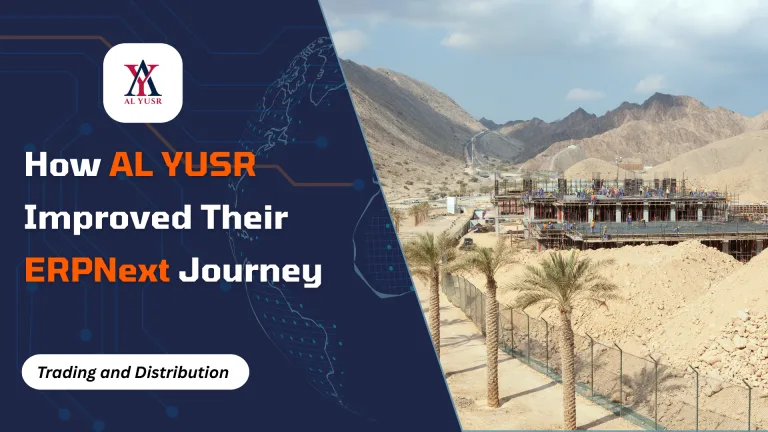
ERPNext was live at AL YUSR International LLC. But that didn’t mean everything was running smoothly.
Day-to-day teams were still facing issues across Purchase, Sales, Stock, Payments, HR & Payroll, and other transactions. Some customizations were creating errors, workflows needed improvement, and business-specific requirements still had to be addressed.
Then came another important step: the upgrade from ERPNext Version 13 to Version 15. Existing customizations had to work with the new version, business processes needed to be validated, and operations had to continue without disruption.
So, the focus was clear: fix what was slowing teams down, stabilize the system, and make ERPNext work better for everyday operations.
That’s where AL YUSR’s post-go-live journey really began.
Client Overview
About Company
Al Yusr International is a trading, distribution, and services company operating across the construction industry in Oman (Middle East). The company’s primary motto is building Oman, and it takes part in this journey by providing construction materials and offering repairs and services for instruments related to the construction, infrastructure, and oil and gas industry.
Formerly a part of Al Ansari Trading Enterprises from 1975 until 2021, Al Yusr has made significant contributions to the country’s development, particularly in residential and commercial towers, mosques, hotels, and industrial and infrastructure projects, including the execution of numerous landmark projects.
Al Yusr remains a trusted partner in Oman’s journey toward sustainable and innovative development. Their successful execution of numerous projects has been instrumental in enhancing Oman’s infrastructure, reflecting their commitment to the nation’s progress.
Industry & Domain
Al Yusr International LLC operates primarily in the Wholesale Building Materials and Construction industries, with headquarters based in Oman.
The company’s domain spans three major divisions:
- Trading: Wholesale and retail of high-quality building materials, tools, and industrial hardware, with showrooms in areas like Ghala and Nizwa, Oman.
- Construction: Civil infrastructure and MEP (Mechanical, Electrical, and Plumbing) services.
- Industrial Services: Electroplating, instrumentation and calibration, as well as rebar cutting and bending.
ERPNext Implementation Journey
The project was initially implemented using ERPNext Version 13. During the implementation, several customizations were developed to meet the client’s business requirements.
Purchase Module
- Configured the complete purchase process, including Purchase Orders, Purchase Receipts, Purchase Invoices, and supplier-related transactions.
- Developed transaction-level customizations to match the client’s purchasing workflow and approval process.
- Customized forms, validations, and reports to improve data accuracy and operational efficiency.
Sales Module
- Implemented the complete sales cycle, including Quotations, Sales Orders, Delivery Notes, Sales Invoices, and customer management.
- Added transaction-level customizations to support the client’s business-specific sales processes.
- Customized workflows, document validations, and reports to simplify daily sales operations.
Accounting Module
- Configured accounting features such as General Ledger, Journal Entries, Payment Entries, Accounts Receivable, and Accounts Payable.
- Developed transaction-level customizations based on the client’s financial and accounting requirements.
- Customized reports and validations to ensure accurate financial records and improve reporting.
HR & Payroll Module
- Implemented employee management, attendance, leave management, payroll processing, and salary structure configuration.
- Customized HR and payroll processes according to the client’s organizational policies and payroll requirements.
- Enhanced payroll calculations, validations, and reports to support accurate salary processing.
After the initial implementation, ongoing support and maintenance were provided for the ERPNext Version 13 environment.
Later, the client upgraded the system from ERPNext Version 13 to Version 15. Following the upgrade, issues caused by version changes were identified and resolved, customizations were validated, and all business processes were checked to ensure they worked as expected. This helped stabilize the system and provided a smooth transition to ERPNext Version 15.
Departments Automated Using ERPNext
- Purchase & Vendor Management
- Sales & Customer Management
- Inventory & Warehouse Management
- Accounting & Finance
- CRM Management
- HR and Payroll Management
The Challenges
- Issues in Purchase, Sales, and Stock Processes
The organization experienced operational challenges across the Purchase, Sales, and Stock modules. These issues affected the smooth execution of daily transactions and created delays in business operations.
- Payment Entry Customization Issues
The Payment Entry module had customizations that caused errors during document submission. As a result, users faced difficulties while processing customer and supplier payments.
- Challenges in HR and Payroll Management
The HR and Payroll modules encountered configuration and processing issues, leading to difficulties in employee record management and payroll generation.
- Print Format and Workflow Issues
The existing print formats and approval workflows did not fully meet the organization’s business requirements. This affected document presentation and approval efficiency.
- Requirement for Business-Specific Customizations
The organization required additional custom features and enhancements that were not available in the standard ERPNext system. These customizations were necessary to support their unique business processes.
- Transaction-Level Issues Across Multiple Modules
Users experienced transaction-related issues across different ERPNext modules. These problems impacted data consistency and interrupted day-to-day business activities.
- Issues After ERPNext Version Upgrade
Following the ERPNext version upgrade, several existing customizations and system functionalities were affected, resulting in compatibility and operational issues.
The Solution
- Optimizing Purchase, Sales, and Stock Processes
To improve operational efficiency, the business workflows were reviewed and optimized through:
- Identifying and resolving process-related issues
- Correcting module configurations and transaction validations
- Improving integration between Purchase, Sales, and Stock modules
- Performing end-to-end testing to ensure smooth business operations
These improvements helped streamline business processes and reduce operational delays.
- Resolving Payment Entry Customization Issues
The customized Payment Entry functionality was reviewed and enhanced by:
- Identifying the root cause of submission errors
- Updating custom scripts and validations
- Testing multiple payment scenarios to ensure reliability
- Ensuring successful payment processing without system interruptions
This resulted in a stable and reliable payment process.
- Improving HR and Payroll Operations
The HR and Payroll modules were optimized by:
- Reviewing HR and payroll configurations
- Resolving payroll calculation and validation issues
- Correcting employee master data where required
- Testing payroll processing for accuracy
These improvements ensured smooth HR operations and accurate payroll processing.
- Enhancing Print Formats and Workflow
The document management process was improved by:
- Customizing print formats based on business requirements
- Refining approval workflows for better process control
- Improving document layout and usability
- Validating workflow functionality across different business scenarios
This ensured consistent document generation and efficient approval processes.
- Implementing Business-Specific Customizations
New features were developed to address the organization’s unique requirements by:
- Understanding business processes and operational needs
- Designing and implementing customized ERPNext solutions
- Integrating new functionality with existing workflows
- Conducting thorough testing before deployment
These customizations improved system flexibility and supported business growth.
- Resolving Transaction-Level Issues Across Modules
To improve transaction reliability, the following actions were taken:
- Investigating issues across multiple ERPNext modules
- Correcting validation and configuration errors
- Ensuring data consistency between related transactions
- Performing comprehensive user acceptance testing
These improvements enhanced overall system stability and transaction accuracy.
- Addressing Issues After ERPNext Version Upgrade
To ensure a successful upgrade, post-upgrade issues were resolved by:
- Identifying compatibility issues in custom developments
- Updating custom scripts and configurations
- Verifying all business processes after the upgrade
- Performing comprehensive regression testing across modules
These efforts ensured system stability and maintained seamless business operations after the ERPNext version upgrade.
Results & Business Impact
Efficiency Improvement
The client recommended an 80% efficiency target, stressing continual progress in processes, reports, and hands-on execution.
Customer Satisfaction
A 94% satisfaction level was recorded.
Key Highlights & Learnings
- User Support & Training
Continuous user training and timely support improved user confidence, reduced errors, and encouraged smooth system adoption.
- Customization Experience
The project provided valuable experience in developing and managing business-specific ERP customizations to meet operational requirements.
- Version Upgrade Learning
Successfully maintaining and adapting custom applications during the ERP version upgrade helped strengthen upgrade and compatibility management skills.
- Transaction, HR & Payroll Improvements
Resolving transaction-level, HR, and payroll issues enhanced system reliability and provided deeper functional and technical knowledge.
- Workflow Optimization
Streamlined buying and selling processes improved operational efficiency and reduced processing time.
- Accurate Inventory Management
Timely and accurate system updates helped maintain reliable inventory records and improved stock visibility.
- Business Reporting
Customized reports provided meaningful insights that supported planning and informed decision-making.
- HyperCare Support
Post-go-live HyperCare support ensured quick issue resolution, a smooth transition, and faster user adoption.
Closing Takeaway
For AL YUSR, the ERPNext journey did not end with go-live. With the right support, process improvements, customizations, and user training, the system became more stable and better aligned with the company’s day-to-day business needs.
Strengthen Your ERPNext Operations
Ready to improve your ERPNext setup and get the right post-go-live support?
Talk to our ERPNext experts and explore how our post go-live support can support your business.
And don’t forget to follow us on LinkedIn!