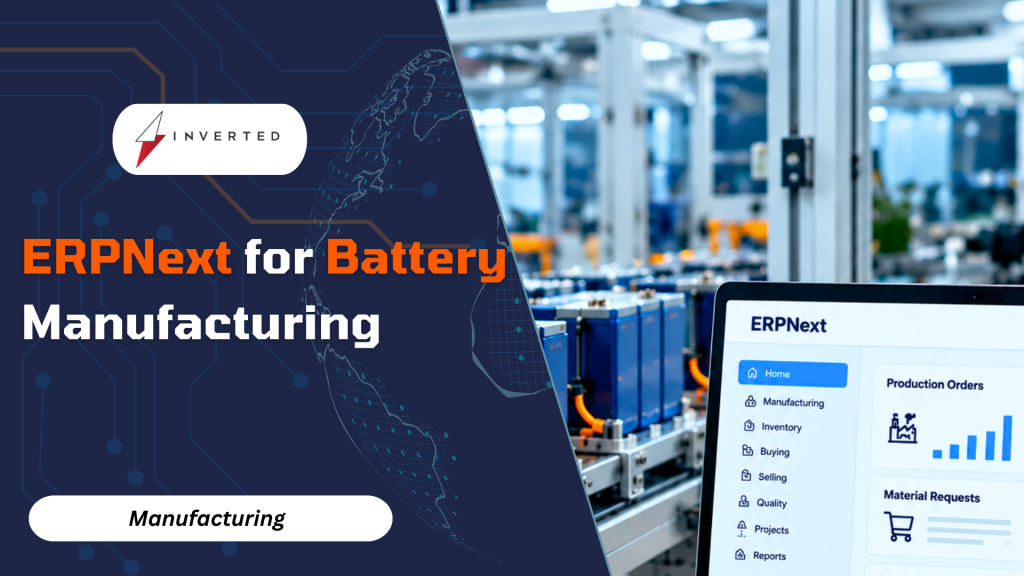
Running a battery manufacturing business means keeping procurement, inventory, production, and reporting moving together. When these processes rely heavily on manual work, even small gaps can slow things down.
Inverted Energy Private Limited needed a more connected way to manage its day-to-day operations, improve inventory visibility, and reduce manual effort.
Indictrans implemented ERPNext V15 to bring these processes together. The 3-month full-lifecycle implementation onboarded 40+ users and went live on schedule.
About Inverted Energy
Inverted Energy Private Limited operates in the battery manufacturing industry, where keeping procurement, inventory, production, and reporting connected is important for everyday operations.
As the business worked to bring more structure to these processes, it needed better visibility, fewer manual steps, and a more reliable way to manage operational data.
Indictrans implemented ERPNext V15 for Inverted Energy as a full-lifecycle ERP implementation, covering the project from kick-off and requirements through development, UAT, training, and go-live.
The implementation was completed in 3 months, with 40+ users onboarded and the project going live on schedule.
The Challenge
As with many growing manufacturing operations, several everyday processes were still dependent on manual work.
- Disconnected Processes
Procurement and inventory processes were not sufficiently connected, making it harder to manage information across teams.
- Limited Inventory Visibility
Untracked inventory created bottlenecks and made it difficult to maintain a clear view of stock.
- Manual Approvals and Reporting
The absence of structured approval workflows meant the team relied on manual approvals and Excel-based reporting.
- High Manual Effort and Rework
Manual processes increased operational effort and created more room for errors and rework.
- Limited Real-Time Information
Teams did not have real-time information readily available for day-to-day decision-making.
The Approach
The goal was straightforward: connect the processes, reduce manual work, and give the team better visibility.
The implementation focused on five key areas:
- Integrating Procurement and Inventory
- Improving real-time stock visibility
- Supporting smoother production
- Using ERPNext workflows for approvals
- Providing live reports for decision-making
Implementing ERPNext for Battery Manufacturing
Indictrans implemented ERPNext V15 as a full-lifecycle solution.
The project moved through:
Kick-off → CRP & Requirements → Development → UAT → Training → Go-Live → Hypercare
All stages were completed, and the project went live on schedule.
With 40+ users onboarded and a 4-member implementation team, the implementation focused on making the system practical for everyday use rather than simply putting the ERP in place.
What Changed?
The implementation connected important operational processes and reduced the amount of manual work involved.
- Procurement and Inventory
ERPNext brought procurement and inventory processes together, giving the team a more connected way to manage stock and related transactions.
- Better Stock Visibility
Real-time inventory information helped the team keep a closer eye on stock and reduce production bottlenecks.
- Structured Approvals
ERPNext workflows replaced manual approval steps with a more structured process.
- Faster Reporting
Live reports reduced the team’s dependence on time-consuming manual reporting and helped provide information for faster decisions.
The Numbers Tell the Story
The implementation delivered measurable improvements across key operational processes.
| Key Area | Before | After | Improvement |
| GRN Processing Time | 24 hrs | 5 hrs | 79% faster |
| Inventory Accuracy | 40% | 100% | 2.5× improvement |
| Production Cycle Time | 48 hrs | 5 hrs | 90% reduction |
| Manual Data Entry | 80% | 10% | 87.5% reduction |
| Reporting Time | 160 min | 40 min | 75% faster |
These changes made a noticeable difference in how quickly teams could process information and move through everyday operations.
From Manual Work to Better Visibility
The project dashboard highlights four major changes:
- 60% Less Manual Effort
Manual processes moved towards automated workflows.
- 80% Faster Operations
Limited visibility was replaced with real-time operational information.
- 95% On-Time Deliveries
Better data and connected processes supported more reliable operations.
- Better Business Decisions
Integrated operations and real-time information gave teams a stronger base for decision-making.
Customizations That Made a Difference
The implementation also included business-specific requirements rather than relying only on standard ERPNext functionality.
- Custom Part Code Logic
An attribute-based dynamic item naming engine was implemented to handle custom part-code requirements.
- Barcode & QR Label Printing
Raw print integration was implemented to support inventory tracking.
These additions helped the ERP system fit the way Inverted Energy manages its manufacturing operations.
What We Learned
The project also highlighted a few practical lessons for future ERP implementations.
- Bring all sign-off stakeholders into CRP.
Having the right stakeholders present during CRP helps avoid gaps in the go-live scope.
- Prepare use cases before UAT
For custom implementations, clearly defined use cases and test cases should be ready before UAT begins.
These are simple steps, but they can make a big difference during implementation.
The Result
With ERPNext in place, Inverted Energy moved from disconnected and manual processes towards integrated operations, better visibility, and faster processing.
Want to see what ERPNext can do for your manufacturing business?
Explore how Indictrans can help you build a more connected way of working.
And don’t forget to follow us on LinkedIn!