About DFM Foods
Running a large packaged food business means keeping a lot of moving parts together, from procurement and inventory to sales, distribution, and coordination across locations.
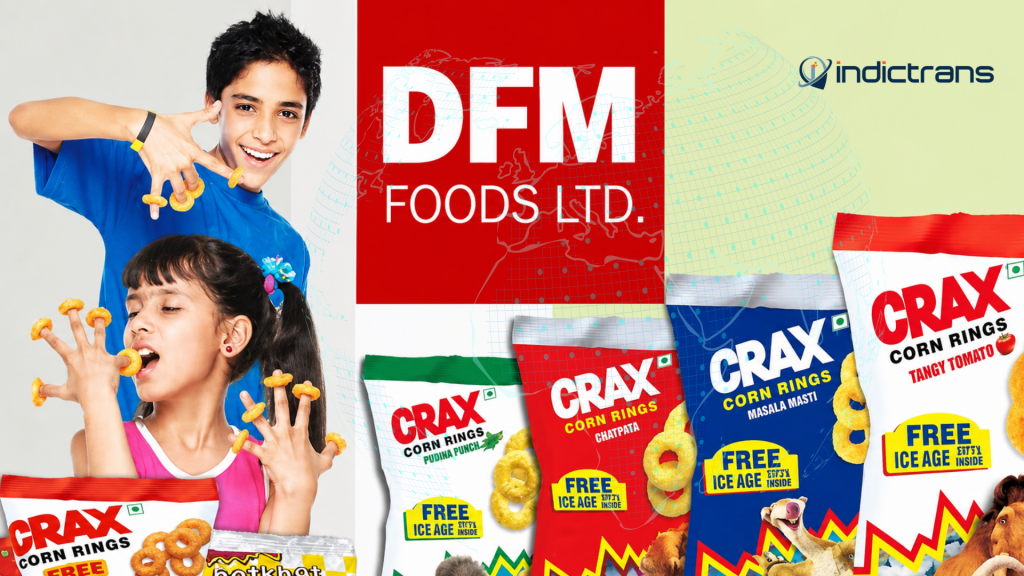
DFM Foods Ltd. is one of India’s leading packaged snack food companies, engaged in the manufacturing, marketing, and distribution of a wide range of savory snacks.
Established in 1993, DFM Foods pioneered the packaged extruded snacks category in India with its iconic CRAX brand. Its product portfolio includes Corn Rings, Curls, Natkhat, Fritts, Cheese Balls, potato chips, and a variety of traditional namkeens.
With modern manufacturing facilities and an extensive distribution network across India, DFM Foods continues to focus on brand innovation, operational excellence, and customer-centric product development.
DFM Foods at a Glance
25+ | 17+ | 53+
Individual Snack Products | Business Locations | Carrying & Forwarding Agents
The Challenge
When operations span multiple locations, disconnected systems can quickly become a bottleneck.
Before ERPNext, DFM Foods was managing business operations across departments without a single centralized platform.
Teams relied on manual coordination, making everyday operations and decision-making more difficult. At the same time, tracking the complete supply chain lifecycle, from procurement to delivery, was a challenge.
As the organization operated across more than 17 locations and managed a large number of users, DFM Foods needed a system that could adapt to its internal workflows and support its growing operational requirements.
The key challenges were
- No centralized platform to manage end-to-end operational activities across departments.
- Manual coordination between teams, slowing down daily operations and decision-making.
- Difficulty tracking the complete supply chain lifecycle, from procurement to delivery.
- Need for a customized system aligned with internal workflows and operational structure.
- Complexity in managing a large number of users across more than 17 locations.
- Need for a flexible and scalable digital platform to support operations, sales, and distribution activities efficiently.
The requirement was not simply to introduce another software system. DFM Foods needed a platform that could bring its operations together while fitting the way its teams already worked.
The Solution
A customized ERPNext solution built around DFM Foods’ workflows
DFM Foods implemented a customized ERPNext solution on the Frappe Framework, following an Agile methodology.
The implementation was carried out through a structured, phased approach, with continuous collaboration between the project team and DFM Foods stakeholders.
1. Understanding the Business Before Building the Solution
The project started with detailed requirement discovery workshops involving key stakeholders from the DFM Foods team.
The focus was on understanding how the business worked today, where the gaps were, and what the new system needed to support.
The process included:
- Mapping existing AS-IS operational processes
- Conducting stakeholder discussions across departments
- Identifying operational gaps and improvement opportunities
- Creating a comprehensive business blueprint
- Obtaining client validation and sign-off before development
This ensured that the solution was designed around DFM Foods’ actual operational workflows and requirements.
2. Customizing ERPNext for Day-to-Day Operations
Once the business blueprint was defined, custom modules were developed within ERPNext to support DFM Foods’ operational lifecycle.
Key Custom Modules
- Loading Advice
- Gate Entry
- Warehouse Mapper
- Kotak Sync Status
- HDFC Sync Status
- Primary Order Upload
- Bizom Item Mapper
- Scheme Claim
- ARS
These custom modules enabled DFM Foods to digitally manage and monitor its operations through ERPNext.
3. Connecting ERPNext with Existing Systems
For a business operating across multiple functions, the ERP system also needs to work with the other systems already part of the workflow.
To strengthen DFM Foods’ digital ecosystem, several external integrations were implemented.
Bizom Integration
The Bizom integration enabled the automatic creation of Quotations and Sales Orders through Excel/Scheduler.
Scheme Claim
The Scheme Claim process enabled the automatic creation of Credit Notes / Sales Returns using an Excel file/Scheduler.
Report Interfaces
Report interfaces were configured to store reports at a remote location.
These integrations helped create a more connected digital ecosystem for running day-to-day operations.
Making the Implementation Work
Phased Deployment & User Acceptance Testing
A system used across multiple departments and locations needs more than development and deployment. Teams need time to test it, provide feedback, and get comfortable using it.
DFM Foods’ system was therefore deployed in phases, allowing teams to validate the platform before full deployment.
During UAT:
- Feedback cycles were conducted with multiple departments.
- Certain delays occurred due to internal decision-making processes.
- Continuous follow-ups helped keep the project aligned with expected timelines.
This iterative testing process helped ensure that the platform was aligned with operational needs before go-live.
Collaboration & Continuous Support
The implementation involved direct collaboration between the project resources and the DFM Foods team.
The teams worked together to identify issues, resolve them, support users, and make the transition easier.
This helped enable:
- Faster issue identification and resolution
- Real-time user support
- Improved collaboration between operational and technical teams
- Faster system adoption
Outcomes & Impact
One platform. Better visibility. More connected operations.
The ERPNext implementation helped DFM Foods move from fragmented systems to a centralised, scalable, and process-driven cloud-based platform.
Despite the initial operational complexities and some resistance to adopting a new system, the phased implementation approach, structured training, and continuous support helped ensure a smooth transition.
Centralized Operations
- All operational activities are now managed through a single integrated platform.
- Multiple disconnected systems previously used across departments have been replaced.
- Improved data accessibility.
- Improved operational visibility.
- Improved reporting accuracy.
End-to-End Supply Chain Visibility
- Enables DFM Foods to track and manage the complete Supply Chain Management lifecycle, from procurement to delivery to clients.
- Supports sales forecasting.
- Enables tracking of vendor payments.
- Provides stock ageing and stock balance reporting.
A More Connected Supply Chain Ecosystem
- Integration with platforms such as Bizom enables the DFM Foods team to create Quotations, Sales Orders, and Credit Notes with ease.
- External integrations have strengthened the connection between different parts of the supply chain ecosystem.
Growing User Adoption
- Structured training programmes supported users during the transition.
- Continuous support helped address challenges as teams adapted to the new system.
- Users gradually adopted the ERPNext platform despite initial resistance.
Business Impact
- Centralized operations across 17+ locations.
- Better visibility across departments.
- Streamlined coordination between teams.
- Improved tracking of the complete SCM lifecycle.
- More efficient management of large-scale operations through a scalable, process-driven cloud-based platform.
The implementation involved close collaboration and continuous support to help users adapt to the new system. This approach to post-go-live support and user adoption is also reflected in our work with Vinyas Innovative Technologies, where structured HyperCare helped teams build confidence and make better use of ERPNext.
The Result
DFM Foods’ ERPNext journey was not just about bringing multiple operations onto one platform. It was about creating a system that could work with the organization’s processes, connect its teams, and support operations at scale.
Today, DFM Foods has a centralized platform that brings greater visibility to its operations across multiple locations while supporting the tracking of its end-to-end supply chain lifecycle.
From procurement and inventory to sales forecasting, vendor payment tracking, reporting, and distribution, ERPNext provides DFM Foods with a stronger digital foundation for managing its large-scale operations.
Looking to streamline your large-scale operations with ERPNext?
Your business may have its own workflows, systems, and operational challenges. ERPNext can be customized to work around them.
Talk to our team about building a customized ERP solution for your organization.
Don’t Forget To Follow Us On LinkedIn!