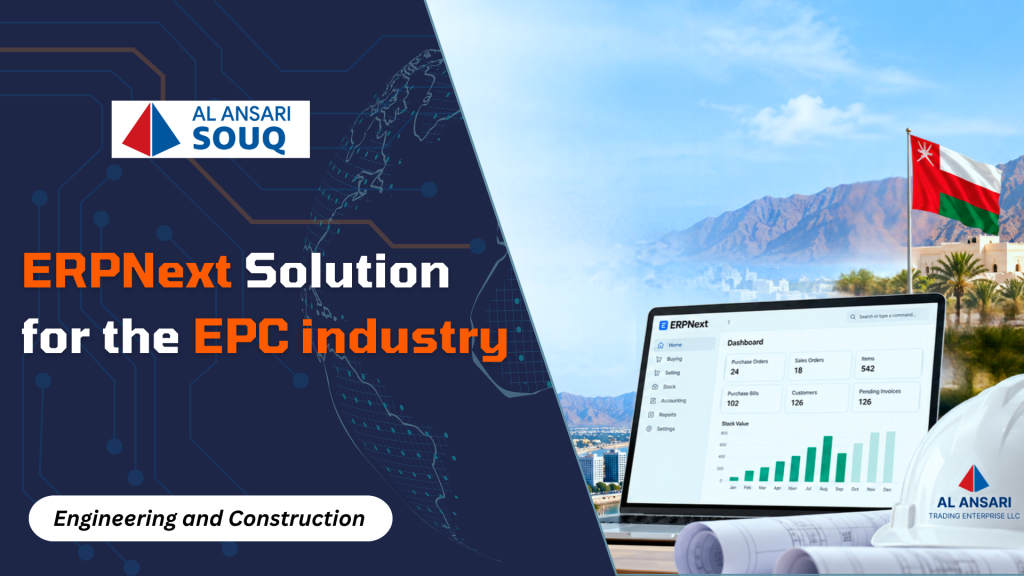
Engineering and infrastructure businesses often manage multiple teams, processes, and day-to-day transactions across different functions. Keeping these operations connected through one ERP system is important for maintaining smooth business workflows.
The company uses ERPNext across key business functions, including Purchase, Sales, Inventory, Accounting & Finance, HR, and Payroll. As teams continued using the system after go-live, they encountered areas that needed improvement across transactions, configurations, workflows, and business-specific requirements.
This case study looks at how the ERPNext setup was improved to better support Al Ansari’s engineering and infrastructure operations in Oman while helping users manage their daily processes more smoothly.
Al Ansari Trading Enterprise LLC is a leading integrated engineering, building, and infrastructure solutions provider established in Oman in 1975. The company has more than 4,000 workers and provides services across water systems, commercial kitchens, and industrial automation across the GCC and India.
Al Ansari operates in the engineering, building services, and infrastructure solutions sector.
Its core business divisions include:
ERPNext was used to manage key business functions across the organization.
Departments Automated Using ERPNext
After go-live, the organization faced challenges across different ERPNext modules and business processes. These issues needed timely attention to keep daily operations running smoothly.
The organization faced challenges across the Purchase, Sales, and Stock modules. These issues affected daily transactions and required timely support.
Some customizations in the Payment Entry process resulted in errors during document submission. Users needed assistance to complete customer and supplier payment activities smoothly.
The HR and Payroll modules required additional attention because of configuration and processing challenges. These issues affected employee record management and payroll processing.
The existing print formats and approval workflows needed further improvements to better match the organization’s business requirements and processes.
The organization required additional enhancements and custom features to support its specific business processes beyond the standard ERPNext functionality.
Users faced transaction-related issues across various ERPNext modules. These required continuous monitoring and support to maintain data accuracy and uninterrupted operations.
The team worked on the identified issues across different modules and business processes to improve system stability and make ERPNext easier for users to work with.
The HyperCare team provided continuous support to identify and resolve issues quickly, helping users perform their daily activities with confidence.
The team reviewed existing customizations, addressed errors, and implemented the required fixes to support smooth transaction processing.
Configuration improvements were made across the Purchase, Sales, Stock, HR, and Payroll modules to better support business requirements.
Print formats and approval workflows were reviewed and enhanced to improve usability and align them with existing business processes.
The team implemented required custom features and improvements to support the organization’s specific operational needs.
Regular monitoring and proactive support helped improve system stability, maintain data consistency, and keep ERP operations running smoothly after go-live.
ERPNext continues to evolve with new features and improvements across different business functions. If you’re planning to move to the latest version, our guide on ERPNext V16 covers the key changes and how they can help businesses reduce friction in their day-to-day operations.
The improvements helped Al Ansari address day-to-day ERPNext issues while supporting users across different business functions.
80% Efficiency Target
The client recommended an 80% efficiency target, with a focus on continual improvement across processes, reports, and hands-on execution.
91% Customer Satisfaction
The project recorded a 91% customer satisfaction level.
These results reflect the focus on timely issue resolution, user support, and keeping ERPNext operations stable.
Al Ansari’s ERPNext journey shows that getting an ERP system live is only one part of the process. As teams start using the system in their everyday work, resolving issues, improving workflows, and supporting users can help maintain stability and improve adoption.
For Al Ansari, continued attention to Purchase, Sales, Inventory, Finance, HR, Payroll, workflows, and business-specific customizations helped the organization keep its ERPNext operations on track.
Take the Next Step with ERPNext.
Looking to improve your ERPNext setup across business processes, configurations, and day-to-day operations?
Talk to our ERPNext experts about your requirements.
And don’t forget to follow us on LinkedIn!
 Gold partner